
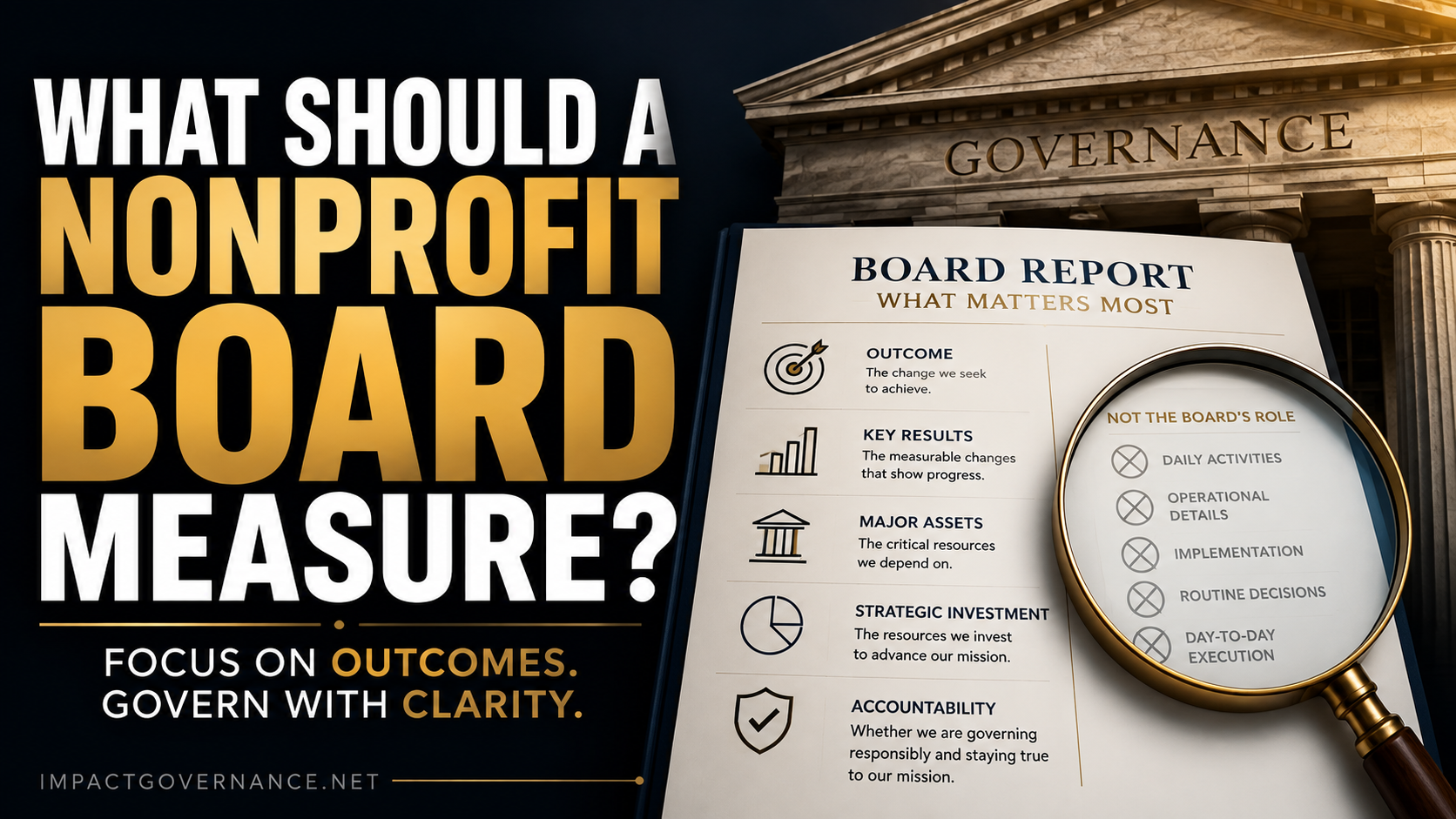
A board can receive dozens of reports every year.
Financial reports. Program reports. Committee reports. Fundraising updates. Staffing updates. Strategic-plan updates.
There may be plenty of numbers on the table.
But here is a more important question:
Are those numbers actually helping the board govern?
That is not always obvious.
A board can spend hours reviewing information and still struggle to answer a basic question:
Are we making meaningful progress toward the change this organization exists to create?
This is where the difference between activity, outputs, results, and outcomes becomes important.
For nonprofit boards, measuring the right things is not simply a reporting issue. It is a governance issue.
The Problem With Measuring Everything

Organizations naturally produce a lot of information.
How many people attended a program?
How many services were delivered?
How many employees participated?
How many applications were processed?
How much money was raised?
How many events were held?
These numbers can be useful. They can tell management whether activities are taking place and whether operations are functioning as expected.
But they do not necessarily tell the board whether the organization is achieving its intended Outcome.
And that distinction matters.
A board should not assume that more activity means more impact.
An organization can deliver more programs and still fail to create the change its Beneficiaries need.
It can increase participation without improving results.
It can raise more money without improving its ability to achieve its purpose.
It can become extremely busy without becoming more effective.
Activity is not the same thing as impact.
What Should a Board Actually Be Looking At?
The answer begins with the organization’s Outcome.
Within the Impact Governance approach, the Outcome describes the change the organization seeks to create in the lives or condition of its Beneficiaries. The Board-Level Plan then connects that Outcome to measurable Outputs, strategic Assets, and the Investment the board is willing to make.
That gives the board a different starting point.
Instead of asking:
What did we do?
the board can also ask:
What changed because we did it?
Those are very different questions.
The first is about activity.
The second begins to address impact.
Activities Still Matter — But They Are Not the Destination
This does not mean boards should ignore Activities.
Programs have to operate.
Services have to be delivered.
Employees have to do their work.
Resources have to be managed.
Activities are necessary.
But Activities are generally part of the Executive Function. The board’s role is not to manage every program or operational decision. It is to provide governance-level direction and hold leadership accountable for meaningful progress.
The distinction between the Governance Function and Executive Function is central to the Impact Governance approach. The board focuses on direction, Results, Assets, Investment, and accountability, while the executive function translates that direction into Activities and execution.
That distinction also helps answer an important question:
What information does the board actually need?
Not every piece of operational information deserves board-level attention.
The board needs enough information to understand performance, identify significant issues, make governance decisions, and hold leadership accountable.
Outputs Are Useful — But They Still Need Context
Outputs can provide an important bridge between Activities and Outcomes.
For example, an organization might track:
- Number of people served
- Number of services delivered
- Number of programs completed
- Number of participants reached
- Number of resources distributed
These measurements can tell the board whether planned work is taking place.
But a board should be careful about stopping there.
Imagine that an organization reports:
10,000 people participated in our program this year.
That sounds impressive.
But what does it mean?
Did participants experience the intended change?
Did the program improve the condition the organization exists to address?
Did the Results move in the right direction?
Was the Investment justified by what was achieved?
Those questions move the conversation from activity to governance.
Results Give the Board Something More Useful to Evaluate
Results provide evidence that progress toward an Outcome is occurring.
This is why the Impact Governance framework connects the Outcome to measurable Outputs and then considers the Activities responsible for producing them.
The board does not necessarily need to monitor every operational measurement.
It needs to understand which measurements tell the governance story.
That might mean asking:
What Results matter most?
Are they improving?
Are they improving at the pace we expected?
What explains the difference?
Does the board need to change its direction or Investment?
These questions create a much more meaningful board conversation than simply reviewing whether management completed its activities.
The Board Should Be Able to See the Line of Sight

One of the most useful ideas in the Impact Governance framework is the line of sight connecting purpose to impact and the resources required to make that impact possible.
The Board-Level Plan connects:
Beneficiary → Outcome → Outputs → Activities → Assets → Investment
The point is not to turn every board meeting into a measurement exercise.
It is to give directors a way to connect individual decisions to the larger purpose of the organization.
For example, suppose the board is considering a significant Investment.
The question should not simply be:
“Can we afford it?”
That is important, but incomplete.
The board can also ask:
What Outcome is this Investment intended to support?
What Results should we expect?
What Assets are involved?
How will we know whether the Investment is producing meaningful progress?
Now the Investment is being considered in a governance context.
A Board Should Not Become a Measurement Department
There is a danger on the other side, too.
Once boards discover the importance of Results, they can sometimes go too far.
A board can become buried in dashboards, metrics, spreadsheets, performance indicators, and operational reports.
That does not necessarily improve governance.
In fact, it can create another form of Board Drift.
The board is no longer asking the important governance questions. It is simply reviewing more data.
The goal is not more measurement.
The goal is better governance information.
A board should be able to understand enough about performance to exercise its responsibilities without taking over management’s role.
That is why role clarity matters.
As we explored in Why Board Governance Training Must Start With Role Clarity, the board and executive work toward the same Outcome but have different responsibilities. Clear roles help prevent governance conversations from turning into operational management.
The Question Behind the Numbers
Perhaps the most useful habit a board can develop is learning to ask:
“So what?”
A report says participation increased.
So what?
A program delivered more services.
So what?
Fundraising exceeded expectations.
So what?
Expenses were below budget.
So what?
The question is not meant to dismiss those accomplishments.
It is meant to connect them to purpose.
What do these numbers tell us about the organization’s ability to achieve its Outcome?
That is where governance becomes more meaningful.
What Happens When Boards Measure the Wrong Things?
The consequences are not always obvious.
A board may conclude that an organization is performing well because its reports show strong activity.
Meanwhile:
- The intended Outcome may not be improving.
- Important Assets may be weakening.
- Investment may not be aligned with priorities.
- The executive may be reporting activity instead of meaningful progress.
- Directors may spend meetings discussing operational details.
- Beneficiaries may disappear from the conversation.
The board remains busy.
But the governance picture becomes less clear.
This is one reason the Impact Governance framework emphasizes keeping the Beneficiary and Outcome visible in board work rather than allowing attention to settle permanently on Activities. The Board-Level Plan is designed to keep that connection alive in agendas, reporting, decisions, evaluations, and board-executive conversations.
The Board-Level Plan Can Help
A Board-Level Plan gives the board a practical way to organize this thinking.
It is not simply another strategic document.
As we explained in How a Board-Level Plan Turns Governance Into a Practical Discipline, its purpose is to help the board connect the people it exists to serve with the Outcome it seeks, the Results that demonstrate progress, the Assets that make the work possible, and the Investment required.
That gives directors a reference point when reviewing reports.
Instead of asking whether every activity was completed, they can ask whether the information being presented helps them understand progress toward the Outcome.
That is a much more useful standard for board reporting.
What Should Be Included in a Board Report?

There is no single reporting package that works for every nonprofit.
But a useful governance report should help directors understand at least four things:
1. Where are we?
What does the current evidence tell us about progress?
2. Where are we trying to go?
What Outcome and Results is the organization working toward?
3. What has changed?
Are Results improving, declining, or remaining unchanged?
4. What does the board need to decide?
Does the information require a change in direction, Investment, stewardship, or accountability?
That last question is particularly important.
A board meeting should not become a presentation where directors simply receive information.
Information should help the board govern.
Better Board Questions Lead to Better Governance

Once a board begins looking at information through this lens, its questions can change.
Instead of:
“Why is this program behind schedule?”
the board might ask:
“Does the delay affect our ability to achieve the intended Result?”
Instead of:
“Why did this department spend more?”
the board might ask:
“Does this change our Investment priorities or affect an important Asset?”
Instead of:
“How many people did we serve?”
the board might ask:
“What evidence do we have that serving those people is producing the intended change?”
The questions become more difficult.
But they also become more useful.
Good Governance Is Not About Having More Data
Boards today have access to more information than ever.
That does not automatically make governance better.
A board can have a 40-page dashboard and still lack a clear understanding of performance.
It can receive monthly reports and still fail to recognize a strategic problem.
It can have sophisticated measurement systems and still spend most of its meeting time discussing Activities.
The challenge is not simply collecting information.
It is knowing which information matters at the governance level.
That requires judgment.
It requires a shared framework.
And it requires directors who understand the difference between monitoring execution and governing organizational impact.
This Is Where Board Governance Training Matters
Boards should not be expected to figure all of this out by accident.
Directors bring valuable experience to the boardroom, but governance is a discipline of its own.
Board members need to understand:
- What belongs to governance
- What belongs to executive management
- How Outcomes and Results should inform board discussions
- How to connect Investment to purpose
- How to steward important Assets
- How to ask meaningful questions
- How to hold leadership accountable without taking over execution
That is why Board Governance Training should be practical.
The objective is not to turn directors into operational analysts.
It is to help them become better governors.
When directors understand what they are looking for—and why—they can spend less time reacting to information and more time using it to govern.
A Better Measure of Board Effectiveness
Perhaps the simplest way to think about this is:
A board should not measure its effectiveness by how much information it reviews.
It should ask whether that information helps it make better governance decisions.
Are directors staying connected to the Beneficiary?
Is the Outcome clear?
Are meaningful Results being tracked?
Are important Assets being stewarded?
Is Investment aligned with priorities?
Is executive accountability clear?
And are board discussions focused on the questions that only the board can answer?
Those are much harder questions than counting how many reports were reviewed.
They are also much closer to the heart of governance.
From Activity to Impact
Nonprofit organizations need Activities.
They need programs, services, people, systems, fundraising, administration, and countless other forms of work.
But the board’s responsibility is not simply to confirm that work is happening.
It is to govern toward the change that work is intended to create.
That means keeping a line of sight between purpose, Outcome, Results, Assets, and Investment.
It means giving management the space to execute while maintaining meaningful board-level accountability.
And it means resisting the temptation to confuse a busy organization—or a busy board—with an effective one.
The most useful question may not be “How much did we do?”
It may be:
“What changed, and what does that tell us about whether we are achieving the Outcome we exist to create?”
That is where measurement becomes governance.
Build the Governance Capability to Ask Better Questions
Good board governance depends on more than receiving the right reports.
Directors need a shared understanding of their responsibilities and a practical framework for interpreting information, asking better questions, and holding leadership accountable without stepping into management.
Board Governance Training from Impact Governance helps boards develop that foundation and strengthen their ability to govern with clarity, discipline, and confidence.
Learn more about Board Governance Training and help your board move from reviewing information to governing for meaningful impact.
Leave a Reply