
A nonprofit board can be full of smart, experienced, committed people and still struggle to govern effectively.
The problem is not always a lack of expertise. Sometimes it is much simpler: people are not completely clear about their roles.
Board members may understand that they are responsible for governance, while the chief executive is responsible for management. But what does that distinction actually mean when a difficult decision lands on the table?
Who decides?
Who advises?
Who is accountable?
Where does the board’s responsibility begin, and where does it end?
These questions are at the heart of effective Board Governance Training.
Why Capable Board Members Still Need Governance Training
Many board members come from professional or activist backgrounds where taking action and solving problems are part of their everyday work. Those skills can be valuable in the boardroom.
But governance asks for something different.
It requires board members to step back from the instinct to solve every problem and instead ask the questions that only governance can answer. It requires curiosity about the Beneficiary, attention to the Outcome the organization exists to create, and the judgment to keep that purpose visible when operational concerns compete for attention.
This is why experience alone is not necessarily enough.
A board can have extensive professional expertise and still need training that creates a shared understanding of how governance works.
Role Clarity Is the Foundation
The relationship between a board and chief executive begins with trust. But in governance, trust is more than believing that everyone has good intentions.
It also means trusting that everyone understands their role and respects the role of the other.
The board and chief executive are working toward the same Outcome, but they do not make the same decisions. When that distinction is unclear, even strong teams can begin stepping on each other. Meetings become filled with questions about who should decide, disagreements about authority, and unnecessary delays.
That is where Role Clarity becomes essential.
When everyone understands where their responsibility begins and ends, conversations become easier, decisions become clearer, and attention can return to the mission.
Governance and Executive Functions Are Different
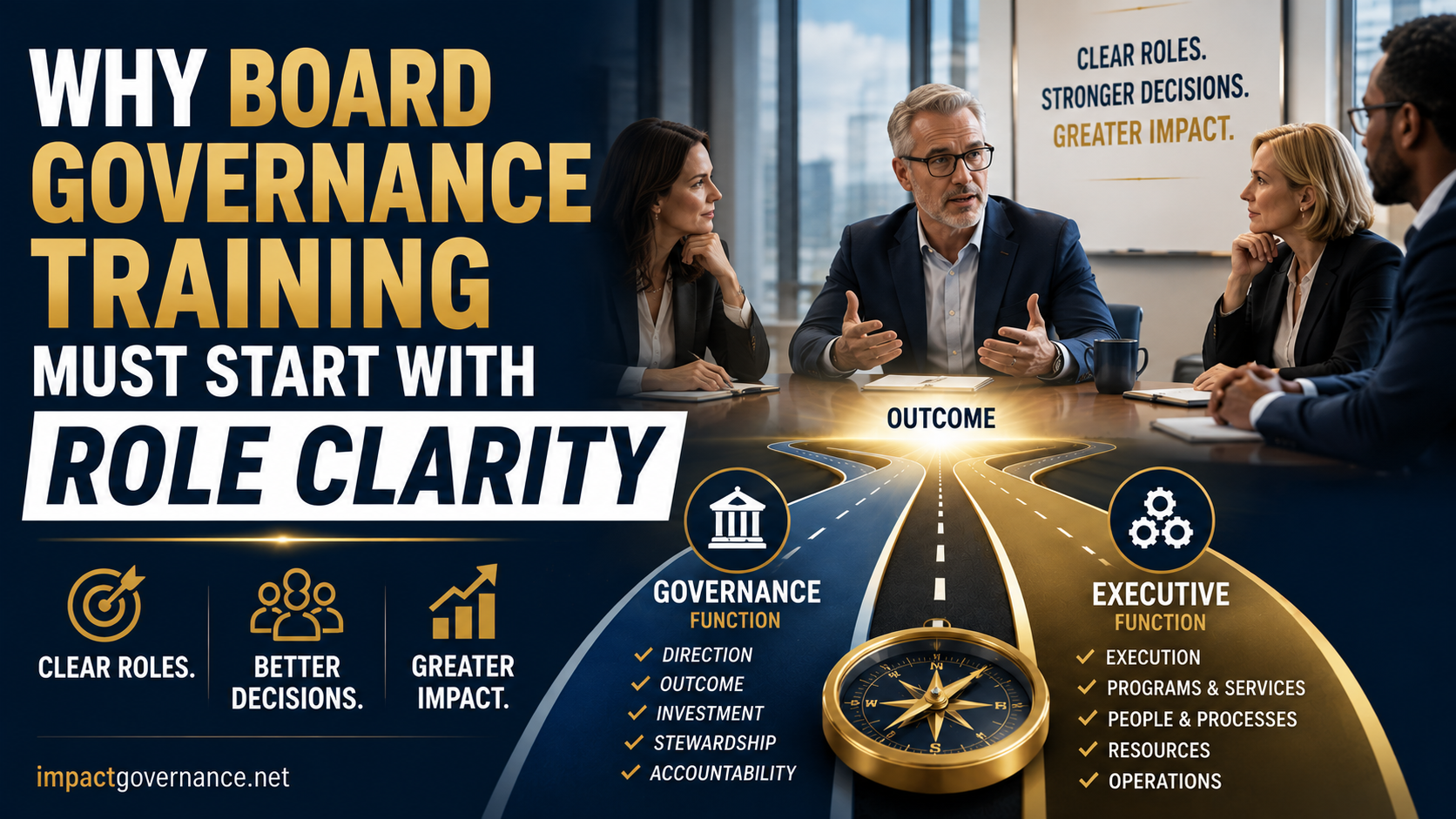
The Impact Governance Model makes this distinction especially practical by separating two functions: the Governance Function and the Executive Function.
Both are necessary. Both contribute to the same Outcome. But they are not interchangeable.
The board’s Governance Function is concerned with direction, desired results, investment, stewardship, and accountability.
The Executive Function is responsible for turning that direction into action.
The book describes the relationship simply: the board determines what should be achieved, while the chief executive determines how it will be achieved. The executive oversees resources, programs, services, operations, people, and processes to make the board’s direction a reality.
This is not about creating distance between the board and executive.
It is about creating clarity.

Think in Two Lanes
One of the most useful ways to understand the model is as a two-lane road.
One lane represents the Governance Function. The other represents the Executive Function. They travel alongside each other toward the same destination: the Outcome.
The Governance lane deals primarily with what and why.
The Executive lane deals primarily with how.
This distinction becomes especially important when board members become involved in activities outside their normal governance role.
A board member may volunteer at an event, help organize supplies, visit beneficiaries, or assist with fundraising. There is nothing inherently wrong with that. But when the board member is acting in an operational capacity, they have temporarily moved into the Executive lane and should understand that they are operating under executive authority.
The important thing is not that board members never cross lanes.
It is that everyone knows which lane they are in.
What Should the Board Actually Decide?
Role clarity becomes much easier when boards practice distinguishing governance questions from executive questions.
Governance questions include:
- Who is the Beneficiary?
- What change are we trying to create?
- What Outcome are we pursuing?
- What results will demonstrate progress?
- How much are we willing to invest?
- What assets must be protected and sustained?
- Is the chief executive performing effectively?
Executive questions are different. They include questions about how resources are used, what programs and services are provided, organizational structure, staffing, procedures, controls, and safeguards.
This distinction does not eliminate discussion between the two functions. In fact, good governance depends on meaningful dialogue.
But dialogue does not mean that every decision belongs to the board.
Clarity about who decides is part of accountability.
When Role Confusion Becomes Board Drift
Without clear roles, boards can gradually lose their connection to the work they are supposed to govern.
Meetings become filled with operational details. Board members begin duplicating staff work. Decisions become harder to make. The board may become increasingly involved in activities while spending less time asking whether the organization is achieving the change it exists to create.
This is where Board Drift can begin.
The Impact Governance approach emphasizes that when role clarity takes hold, board members stop inventing tasks for themselves and begin seeing a clearer connection between decisions in the boardroom and real change for Beneficiaries.
The solution is not to make boards less engaged.
It is to make their engagement more purposeful.

Training Should Be Practical, Not Just Informational
This is where effective Board Governance Training matters.
A useful training program should not simply give new board members a collection of policies or definitions. It should help them recognize governance decisions in real situations and develop a shared language for working with the chief executive.
Board members need opportunities to practice asking:
Is this a governance question or an executive question?
Are we focused on the Outcome or on an operational Activity?
Are we governing, or are we trying to manage?
Those questions can change the quality of a board meeting.
Impact Governance describes its training as focusing on governance principles, board effectiveness, leadership alignment, and decision-making frameworks designed to strengthen organizational performance.
For a board that wants to build this shared understanding, Board Governance Training can provide a structured way to strengthen governance knowledge, role clarity, and decision-making.
Clarity Creates Confidence
When the board understands its role, the chief executive has greater room to lead.
When the chief executive understands what the board expects, accountability becomes clearer.
And when both functions understand how their responsibilities connect, the organization can spend less energy negotiating roles and more energy pursuing its Outcome.
That is ultimately what role clarity is about.
It is not about building walls between governance and management.
It is about creating two clear lanes moving toward the same destination.
Stronger Boards Begin With Clearer Roles
A board does not become effective simply because it has experienced people around the table.
It becomes effective when those people understand how to govern together.
That means understanding the Beneficiary, keeping the Outcome visible, knowing which decisions belong to governance, respecting executive authority, and remaining accountable for the organization’s direction and impact.
The foundation is clarity.
And for boards looking to develop that clarity across new and existing members, Board Governance Training can turn good intentions and professional experience into a shared, practical approach to governance.
Leave a Reply