
A board can be made up of experienced executives, respected community leaders, financial experts, attorneys, entrepreneurs, and passionate advocates for an organization’s mission—and still struggle to govern effectively.
The problem is not necessarily a lack of commitment or intelligence.
Often, it is a lack of shared understanding about what governance actually requires.
Board members may arrive with different professional experiences, different expectations, and different ideas about what their role should look like. Some may become deeply involved in operational decisions. Others may remain too distant from the organization’s performance. Meetings can become dominated by reports, approvals, and activities rather than the questions that belong at the governance level.
This is where Board Governance Training becomes important.
Effective training is not simply about teaching directors more information. It is about helping a board develop a common language, understand its responsibilities, establish appropriate boundaries with executive leadership, and develop the confidence to govern rather than manage.
At Impact Governance, we believe that process begins with role clarity.
Board Governance Training Starts With Role Clarity

Before a board can govern effectively, its members need to understand what they are actually responsible for.
This is why we previously examined Why Board Governance Training Must Start With Role Clarity.
The distinction is fundamental.
The Governance Function belongs to the board. The Executive Function belongs to the chief executive and management.
They are different functions, but they are not competing functions.
They should operate in separate lanes while remaining aligned around the same Outcome. Within the Impact Governance Model, governance focuses on direction, purpose, accountability, Assets, Investment, and measurable progress, while execution is responsible for carrying that direction into the organization’s Activities.
Without this distinction, even highly capable people can find themselves working against one another.
A board member may believe that asking detailed operational questions demonstrates engagement.
An executive may experience those same questions as interference.
The board may believe it is exercising oversight.
The executive may believe the board is attempting to manage.
Training can help both sides understand where their responsibilities begin and where they end.
That clarity creates room for something much more productive:
a board and executive team working toward the same destination without trying to occupy the same lane.
Professional Expertise Does Not Automatically Create Governance Expertise
One of the most common misconceptions about boards is that assembling highly accomplished people automatically produces an effective governing body.
It does not.
A financial professional may understand financial statements exceptionally well without knowing which financial questions belong at the governance level.
An experienced executive may understand organizational operations without automatically understanding what it means to govern as a director.
A lawyer may understand legal risk without knowing how that risk should be considered within the board’s broader responsibility for the organization’s Outcome.
Expertise matters.
But governance is its own discipline.
Board members need to understand how their individual expertise contributes to collective governance without allowing that expertise to pull the board into operational management.
This is one of the reasons effective Board Governance Training begins with a shared framework rather than assuming that experienced people will naturally arrive at one.
What Should Board Governance Training Actually Teach?
Board Governance Training should help directors understand how to govern together.
That means moving beyond general discussions about leadership and focusing on the questions that define effective governance.
A board should be able to discuss:
- Who does the organization exist to serve?
- What Outcome is the organization trying to create?
- What Results demonstrate meaningful progress?
- Which Assets must the board steward?
- What level of Investment is appropriate?
- What decisions belong to the board?
- What decisions belong to the executive?
- How should the board hold leadership accountable?
- How should board meetings remain focused on governance?
Within the Impact Governance Model, governance connects the Beneficiary, Outcome, Results, Activities, Assets, and Investment while maintaining clear boundaries between governance and execution.
That gives directors something more useful than a list of responsibilities.
It gives them a way to think about their responsibilities.
From Understanding Governance to Practicing Governance
Knowing the difference between governance and management is important.
But understanding the distinction intellectually is not enough.
The real test is what happens when the board is sitting around the table and an important decision appears.
Consider a proposed new program.
A board operating primarily at the operational level might ask:
How many employees will we need?
Which vendor should we use?
When can we launch?
What software will we need?
Those questions may be legitimate.
But they may not be the questions the board itself needs to answer.
A governance-focused board might begin somewhere else:
How does this proposed initiative contribute to the Outcome we exist to achieve?
Then:
What Results would demonstrate that it is working?
What Assets are involved?
What Investment is required?
What accountability should the board maintain?
That is the difference between simply participating in organizational discussions and actually governing.
Training should help directors make that shift.
The Board Needs a Practical Governance Framework

This is where governance training becomes much more powerful when it is connected to something the board can continue using.
As we explored in How a Board-Level Plan Turns Governance Into a Practical Discipline, a Board-Level Plan should not become another document that is approved and then placed on a shelf.
The Board-Level Plan provides a practical way for directors to connect governance conversations to the organization’s purpose and measurable impact.
Within the Impact Governance approach, it defines the board’s understanding of the:
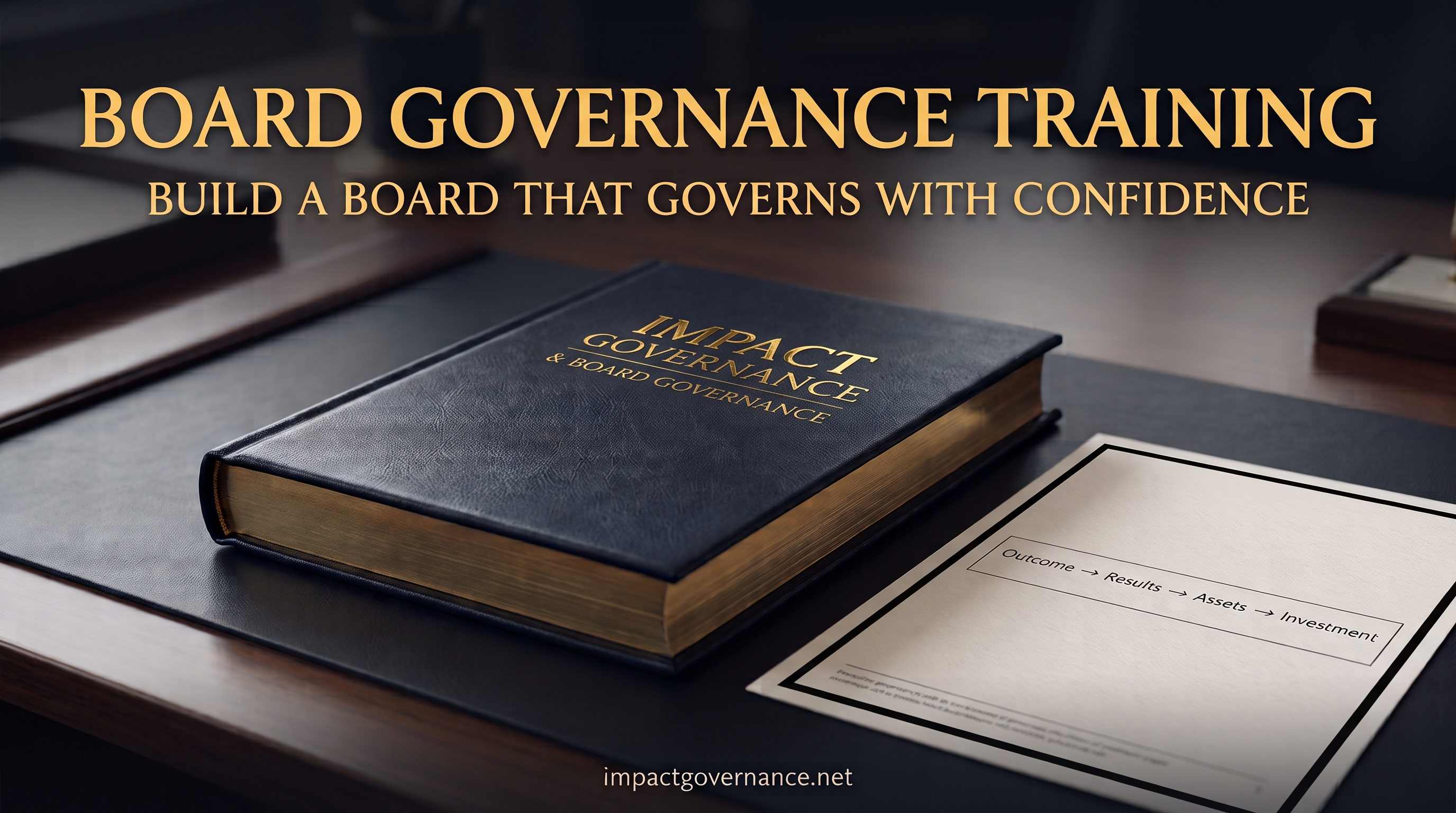
Beneficiary → Outcome → Results → Assets → Investment
The Board-Level Plan therefore gives directors something to return to when circumstances change or difficult decisions arise. It helps keep board discussions connected to purpose rather than allowing them to drift into the details of management.
That is particularly important because governance is not something a board practices once a year.
It happens continuously.
Training Should Not End When the Training Session Ends
A board can attend a governance workshop, receive a presentation, and leave with a folder full of materials.
That does not necessarily mean governance has improved.
The real question is:
What changes after the training?
Do directors ask different questions?
Do meetings become more focused?
Does the board spend less time discussing Activities and more time discussing Outcomes and Results?
Do directors understand which decisions belong to them?
Does the chief executive have greater clarity about what the board expects?
Does the board have a common framework to return to when circumstances become difficult?
These are the indicators that training has moved from information to practice.
The Impact Governance book makes this distinction explicitly: the framework should not become something boards simply read and forget. It should be used when decisions are difficult, in board evaluation, in executive evaluation, and in the ongoing relationship between the board and chief executive.
Training creates the understanding. Practice creates the discipline.
Board Governance Training Can Help Prevent Board Drift

One of the challenges boards face over time is what we call Board Drift.
A board may begin with a clear sense of purpose.
Then gradually, meetings become more crowded.
Reports become longer.
Operational issues receive more attention.
Routine approvals take up more time.
Committees begin bringing increasingly detailed matters to the full board.
Eventually, directors may spend much of their available time discussing what the organization is doing rather than whether the organization is achieving the change it exists to create.
The Impact Governance Model describes Board Drift as the gradual movement of board attention away from the Beneficiary and Outcome and toward Activities, operations, and routine board business.
Training can help directors recognize this pattern.
A useful question during a board meeting can be remarkably simple:
“Is this a governance question or an executive question?”
That question alone can change the direction of a conversation.
The Board-Level Plan Helps Turn Training Into a Habit
This is why the relationship between Board Governance Training and the Board-Level Plan is so important.
Training can establish a shared understanding.
The Board-Level Plan can give that understanding a practical home.
Instead of teaching directors a framework and expecting them to remember it months later, the board can use the framework repeatedly.
It can return to it when:
- evaluating organizational performance
- discussing Results
- considering new Investment
- reviewing important Assets
- evaluating the chief executive
- recruiting new directors
- onboarding new board members
- preparing board agendas
- confronting difficult decisions
The goal is not to create another layer of administration.
The goal is to make governance more disciplined and more useful.
As the Impact Governance framework explains, the Board-Level Plan is intended to keep board discussions focused on purpose and measurable impact rather than management details.
Good Governance Requires a Strong Board-Executive Relationship
Board Governance Training should also address one of the most sensitive relationships in any organization: the relationship between the board and the chief executive.
The objective should not be to create greater separation for its own sake.
It should create greater clarity.
The board and executive should understand:
What belongs to the board?
What belongs to the executive?
Where do they need to collaborate?
Where does accountability sit?
The Impact Governance approach describes these as separate lanes of accountability. The two functions remain distinct while staying aligned around the same Outcome.
That distinction protects both sides.
The board does not need to become a shadow management team.
The chief executive does not need to determine what the board is allowed to discuss.
Instead, both can return to an objective framework when difficult questions arise.
For example:
Does this change the Outcome?
Does it affect an important Asset?
Does it require a different level of Investment?
Or is this an Executive Function matter?
Those questions can prevent confusion before it becomes conflict.

Governance Training Should Create Better Questions
Perhaps the most valuable result of effective training is not that directors know more terminology.
It is that they ask better questions.
A board that receives a financial report does not simply need to know whether the numbers are accurate.
It needs to understand what those numbers mean for the organization’s ability to achieve its Outcome.
A board reviewing a new initiative does not necessarily need to determine how staff should execute it.
It needs to understand whether the initiative contributes to the intended Outcome, what Results should be expected, what Assets are involved, and what Investment is appropriate.
A board reviewing executive performance should not simply ask whether the chief executive completed a list of activities.
It should ask whether the organization is making meaningful progress toward the Outcome and whether leadership is effectively translating governance direction into execution.
That is governance discipline.
Why This Matters Even More as Organizations Face New Challenges
The environment in which boards operate will continue to change.
Technology is changing.
Artificial intelligence is changing how organizations work and make decisions.
Cybersecurity risks continue to evolve.
Workforce expectations change.
Financial pressures change.
Regulatory expectations change.
New opportunities emerge.
Boards cannot predict every challenge that will appear.
They can, however, develop a governance framework that helps them respond to those challenges.
When something new appears, directors can return to the fundamentals:
Who are we serving?
What Outcome are we trying to achieve?
What Results tell us whether we are progressing?
What Assets are at stake?
What Investment is required?
What belongs to governance?
What belongs to execution?
That is one of the advantages of a governance framework built around enduring principles rather than temporary circumstances.
Board Governance Training Is About Building Confidence
The ultimate goal of Board Governance Training is not to turn every director into a governance expert overnight.
It is to create a board that can govern with greater clarity, consistency, and confidence.
Confidence does not mean that directors always know the answer.
It means they know how to approach the question.
They understand their responsibility.
They know when an issue belongs at the governance level.
They know when to rely on executive leadership.
They know what information they need.
They know how to evaluate progress.
And they have a shared framework for difficult decisions.
That is a much more meaningful definition of board effectiveness than simply having a group of talented people in the room.
Building a Culture of Governance
Governance becomes stronger through repeated practice.
The language becomes shared.
Expectations become clearer.
Board discussions become more consistent.
New directors can be introduced to the same framework.
The Board-Level Plan can become part of how the board works rather than another document it occasionally reviews.
The board and chief executive can develop a common understanding of accountability.
And over time, governance becomes less dependent on individual personalities and more embedded in the organization’s leadership culture.
The Impact Governance approach emphasizes that clarity helps boards and chief executives establish a shared foundation for difficult decisions, while keeping attention on the people the organization exists to serve.
That is ultimately what good training should accomplish.
Not simply more knowledge.
But better governance practice.
Build a Board That Governs With Confidence
A board does not become effective simply because talented people are sitting around the same table.
Effective governance requires a shared understanding of responsibilities, a practical framework for decision-making, clear accountability, and the confidence to remain focused on the Outcome the organization exists to achieve.
Board Governance Training can help create that foundation.
Through a practical approach to governance, boards can develop greater role clarity, strengthen their board-executive relationship, improve the quality of their questions, and turn governance principles into consistent practice.
Learn more about Board Governance Training and discover how Impact Governance can help your board govern with greater clarity, confidence, and discipline.
Leave a Reply