
One of the Most Common Mistakes Boards Make
Walk into almost any nonprofit board meeting, and you’ll notice a familiar pattern.
The agenda is filled with program updates, operational reports, financial summaries, fundraising activities, committee reports, and upcoming events. Directors spend hours discussing what the organization is doing, how projects are progressing, and whether planned activities have been completed.
These conversations are important.
But they also reveal one of the most common governance challenges nonprofit boards face.
Too often, boards begin their discussions with activities instead of outcomes.
This may seem like a subtle difference, but it fundamentally changes how governance is practiced.
Organizations that focus primarily on activities often become occupied with managing what exists today. Organizations that begin with outcomes govern toward the future.
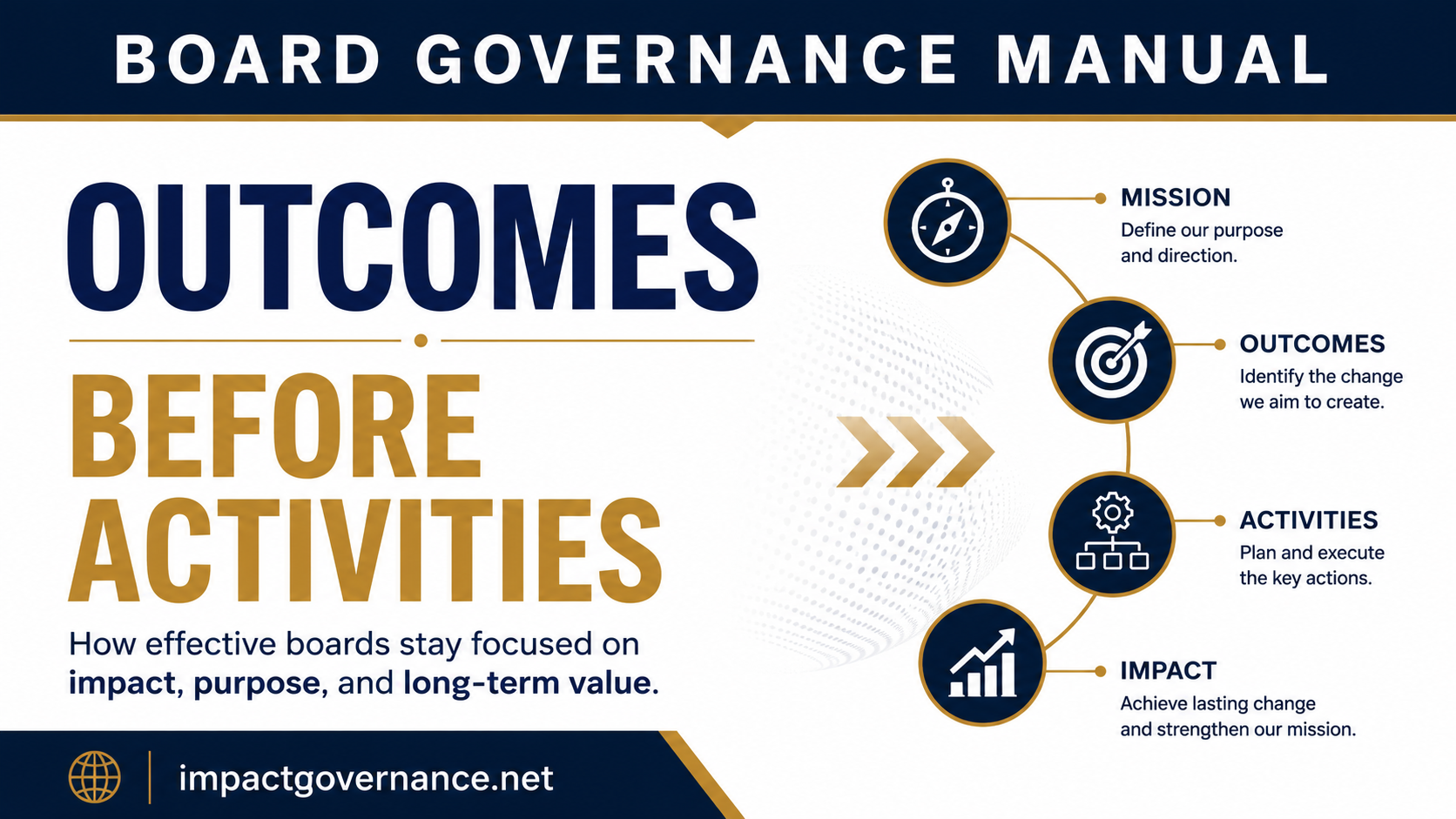
This distinction is one of the defining principles of the Impact Governance® Board Governance Manual, where governance begins by asking what change the organization exists to create before considering how that change will be achieved.

Activities Show Motion—Outcomes Demonstrate Purpose
Activity is easy to measure.
Boards can quickly review:
- Programs delivered
- Meetings held
- Volunteers recruited
- Funds raised
- Events completed
- Services provided
These indicators describe effort.
They explain what the organization has done.
However, governance exists to answer a different question.
Did those activities create meaningful change?
That is where outcomes become essential.
Outcomes measure the lasting difference an organization makes in the lives of the people or communities it serves.
From a governance perspective, outcomes—not activities—define success.
What Is Nonprofit Board Governance Really Measuring?
Organizations frequently ask:
What is nonprofit board governance?
Governance is often described as oversight.
While that is true, oversight alone does not explain what boards are responsible for achieving.
Governance provides direction.
It establishes priorities.
It protects organizational purpose.
Most importantly, governance continually evaluates whether the organization is moving toward its intended outcomes.
This perspective changes the role of the board.
Rather than simply reviewing reports, directors begin examining whether organizational resources, leadership decisions, and strategic priorities continue to support meaningful impact.
Why Boards Naturally Drift Toward Activities
Boards rarely intend to become operational.
In most cases, the transition happens gradually.
Management prepares reports focused on daily operations.
Committees present updates on completed work.
Financial reports emphasize spending and implementation.
Over time, these conversations dominate meeting agendas.
Directors begin evaluating how work is being performed instead of why it matters.
Without realizing it, governance slowly shifts toward operational oversight.
The result is not ineffective leadership.
It is misplaced attention.
Strong governance continually redirects attention back toward outcomes.
A Governance Framework That Begins With Purpose
Within the Impact Governance® methodology, governance starts with purpose before discussing programs, projects, or operational activity.
This creates an entirely different sequence for governance conversations.
Instead of asking:
“What activities are we performing?”
Boards first ask:
- What outcomes are we pursuing?
- Who are our intended beneficiaries?
- How will meaningful change be measured?
- What outputs demonstrate progress?
- Which activities best support those outcomes?
Only after those questions are answered do activities become relevant.
This sequence helps governance remain strategic instead of operational.
Outcomes Create Better Governance Conversations
When outcomes become the starting point, board discussions naturally improve.
Directors begin exploring questions such as:
- Are we measuring what truly matters?
- Are our resources producing measurable impact?
- Have organizational priorities changed?
- Which initiatives contribute most effectively to our mission?
- Are today’s activities still aligned with our intended outcomes?
Notice that none of these questions require directors to manage staff or oversee daily operations.
Instead, they reinforce governance responsibilities while respecting the Executive Function.
Governance Is About Stewardship, Not Supervision
Many people assume boards exist to supervise operations.
In reality, governance provides stewardship.
Stewardship means ensuring the organization remains capable of fulfilling its mission not only today but years into the future.
That requires directors to continually evaluate whether resources, investments, partnerships, and strategic priorities remain aligned with desired outcomes.
This perspective allows governance to maintain long-term focus while executive leadership manages implementation.

Why Outcome-Focused Boards Make Better Decisions
Every governance decision ultimately answers one question:
Will this help us achieve our intended outcomes?
When boards adopt this perspective, decision-making becomes more consistent.
Programs are evaluated according to impact.
Resources are allocated according to purpose.
Strategic priorities remain connected to mission.
Governance discussions become more meaningful because directors evaluate success according to lasting organizational value rather than completed activities alone.
This shift strengthens accountability while encouraging thoughtful leadership.

From Activities to Impact
Every nonprofit organization performs activities.
Only effective governance ensures those activities create meaningful outcomes.
The board’s responsibility is not to manage programs.
Its responsibility is to ensure those programs remain connected to organizational purpose.
When governance consistently begins with outcomes, organizations become better positioned to adapt, innovate, and create lasting value for the communities they serve.
Final Thoughts
Exceptional governance begins with a simple but transformative shift in perspective.
Rather than asking what the organization is doing, boards first ask what change the organization exists to create.
That single question influences every governance discussion that follows.
By focusing on outcomes before activities, directors strengthen accountability, improve strategic oversight, and ensure governance remains centered on long-term organizational impact rather than day-to-day operations.
It is a disciplined approach to leadership—one that helps nonprofit boards govern with greater clarity, purpose, and effectiveness.
Continue Strengthening Your Board’s Governance
Every nonprofit board benefits from practical governance resources that help transform principles into consistent leadership practices.
Choose the resource that best supports your organization’s next step.
📘 Board Governance Manual (Recommended for this article)
Build a practical governance framework based on the Impact Governance® methodology and strengthen your board’s ability to govern with clarity, accountability, and purpose.
🎓 Board Governance Training
Equip your board with practical governance knowledge that improves strategic thinking, decision-making, and leadership effectiveness.
🤝 Schedule a Governance Consultation
Looking for governance guidance tailored to your organization?
Our consulting services help nonprofit boards strengthen governance systems, leadership, and long-term organizational effectiveness.
Leave a Reply