
Governance Doesn’t Improve by Reacting—It Improves by Preparing
Every week brings new developments that remind nonprofit leaders an important truth: strong governance is not built during moments of crisis—it is built through consistent preparation, thoughtful oversight, and disciplined leadership.
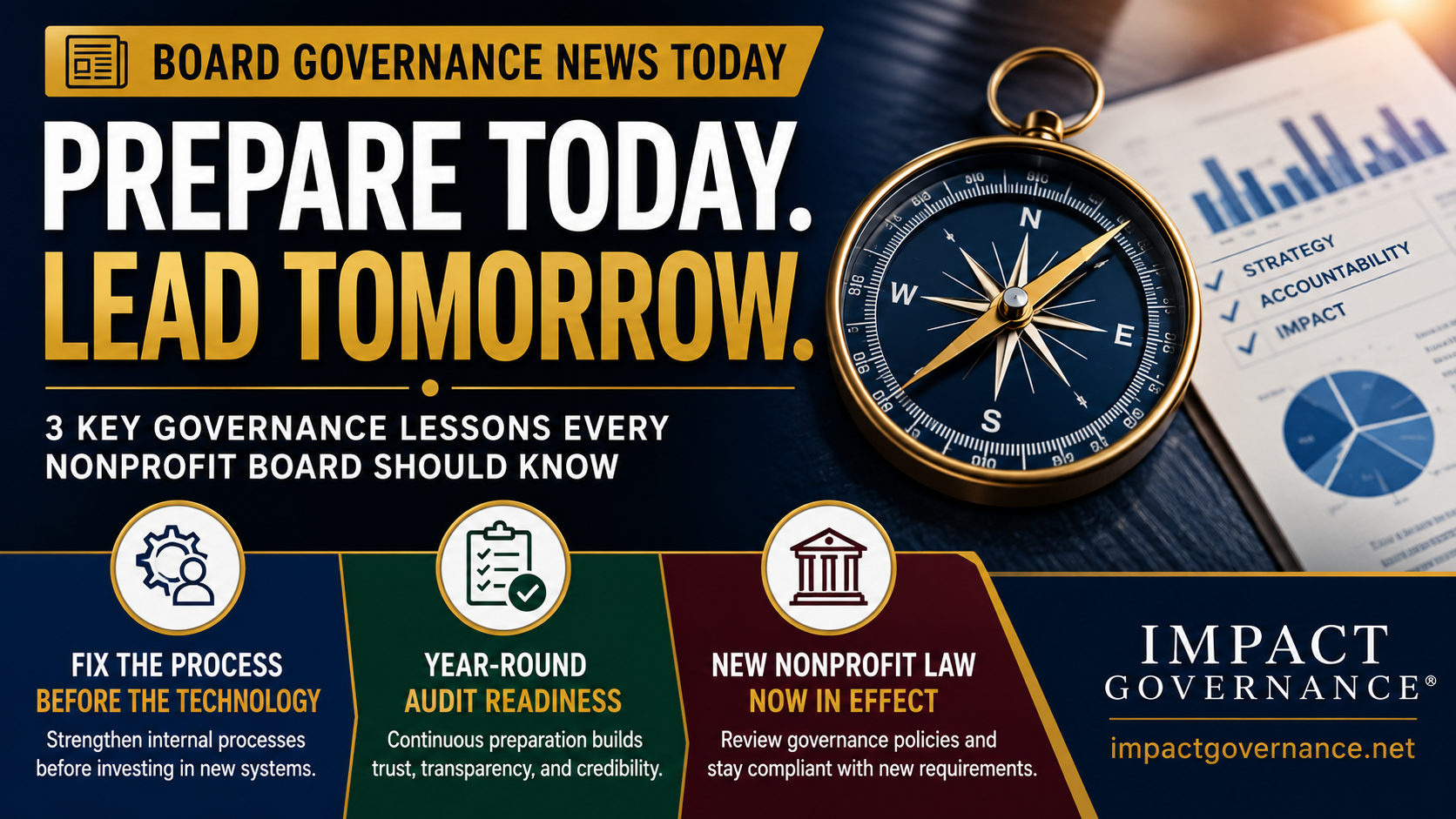
This week’s governance news highlights three different areas of nonprofit leadership:
- Operational systems and governance oversight
- Financial accountability and audit readiness
- Governance responsibilities under changing legal frameworks
Although each story focuses on a different topic, they all reinforce one essential governance principle:
Boards create stronger organizations when they focus on systems, accountability, and long-term stewardship rather than reacting only when problems arise.
Let’s examine this week’s developments and the governance lessons nonprofit boards can apply.

1. Technology Cannot Replace Good Governance
Many nonprofit organizations assume that implementing a new customer relationship management (CRM) platform will automatically improve fundraising, donor engagement, or organizational performance.
A recent article published by NonProfit PRO challenges that assumption, arguing that technology alone cannot solve underlying organizational problems. Instead, nonprofits often need to strengthen their internal processes before investing in new software.
📖 Read the original article:
Governance Perspective
Boards rarely choose software.
However, boards are responsible for ensuring the organization has sound governance systems.
Technology should support governance—not replace it.
Directors may wish to ask questions such as:
✔ Are our governance processes clearly defined?
✔ Do reports help us make better decisions?
✔ Are technology investments aligned with strategic priorities?
✔ Are we solving operational symptoms instead of governance challenges?
Strong governance begins with systems that support accountability and decision-making, regardless of which technology platform an organization uses.

2. Audit Readiness Is a Governance Responsibility
Preparing for an audit should never become a last-minute exercise.
A recent article from MNP explains how nonprofit organizations benefit from maintaining audit readiness throughout the year by strengthening financial processes, documentation, and reporting practices. The article emphasizes that continuous preparation reduces risk, improves transparency, and strengthens organizational credibility.
📖 Read the original article:
Governance Perspective
Although management oversees daily financial operations, boards remain responsible for governance oversight.
Effective governance encourages questions such as:
- Are financial reports timely and understandable?
- Do our internal controls support accountability?
- Are governance policies reviewed regularly?
- Is the board receiving the information needed to fulfill its fiduciary responsibilities?
Audit readiness is ultimately about more than compliance.
It strengthens confidence among donors, funders, regulators, and the communities nonprofit organizations serve.
Strong Governance Requires Strong Foundations
Well-prepared boards don’t wait for governance challenges to appear before strengthening their leadership practices.
Organizations seeking practical guidance can explore the Impact Governance® Board Governance Manual, which provides a governance framework centered on accountability, stewardship, and measurable organizational outcomes.
👉 https://impactgovernance.net/board-governance-manual/
3. Florida’s New Nonprofit Law Highlights the Importance of Governance Review
Florida’s updated nonprofit legislation, which took effect on July 1, modernizes significant portions of the state’s nonprofit corporation law. The changes affect governance practices, member rights, officer standards of conduct, restructuring procedures, and governance documentation for many nonprofit organizations organized under Florida law. Organizations are encouraged to review governing documents and governance policies to ensure alignment with the revised statutory framework.
📖 Read the original article:
Governance Perspective
Every legislative update provides an opportunity for boards to reflect on governance practices.
Whether or not an organization operates in Florida, boards can ask:
✔ Are our bylaws current?
✔ Have governance policies been reviewed recently?
✔ Do directors understand their fiduciary responsibilities?
✔ Are governance practices evolving alongside regulatory expectations?
Strong governance is proactive rather than reactive.
Regular governance reviews help organizations remain resilient as legal and operational environments change.
One Governance Lesson Connects Every Story
At first glance, these three articles discuss different subjects.
Technology.
Financial reporting.
Legislation.
However, each points toward the same governance principle.
Organizations become stronger when governance focuses on building systems before problems emerge.
Boards that encourage disciplined processes, transparent oversight, and continuous governance improvement place their organizations in a better position to respond to change with confidence.
Effective governance is rarely about reacting quickly.
More often, it is about preparing thoughtfully.
Turning Governance News into Better Governance
Current events provide valuable learning opportunities.
The organizations that benefit most are those that convert these lessons into stronger governance practices.
Whether reviewing internal systems, strengthening financial oversight, or evaluating governance policies, nonprofit boards should remain committed to continuous improvement.
The Impact Governance® Board Governance Manual offers a practical framework that helps boards strengthen accountability, clarify responsibilities, and maintain strategic focus.
👉 https://impactgovernance.net/board-governance-manual/
Boards seeking to strengthen leadership through education can also explore Board Governance Training.
👉 https://impactgovernance.net/board-governance-training/
Final Thoughts
This week’s governance developments demonstrate that effective governance is not limited to board meetings or policy documents.
It is reflected in how organizations build systems, maintain accountability, prepare for oversight, and adapt to changing governance expectations.
Boards that consistently invest in governance improvement are better equipped to guide their organizations through both opportunities and challenges while remaining focused on their mission and the communities they serve.
Continue Strengthening Your Board’s Governance
Whether your organization is reviewing governance policies, improving board effectiveness, or preparing for future challenges, Impact Governance® offers practical resources designed specifically for nonprofit leaders.
Choose the resource that best supports your board’s next step.
🤝 Schedule a Governance Consultation (Recommended for this article)
Receive practical guidance tailored to your organization’s governance challenges and long-term leadership goals.
📘 Explore the Board Governance Manual
Build a stronger governance framework centered on accountability, stewardship, and measurable organizational impact.
🎓 Board Governance Training
Help your board strengthen strategic leadership, improve decision-making, and fulfill its governance responsibilities with confidence.
Leave a Reply