
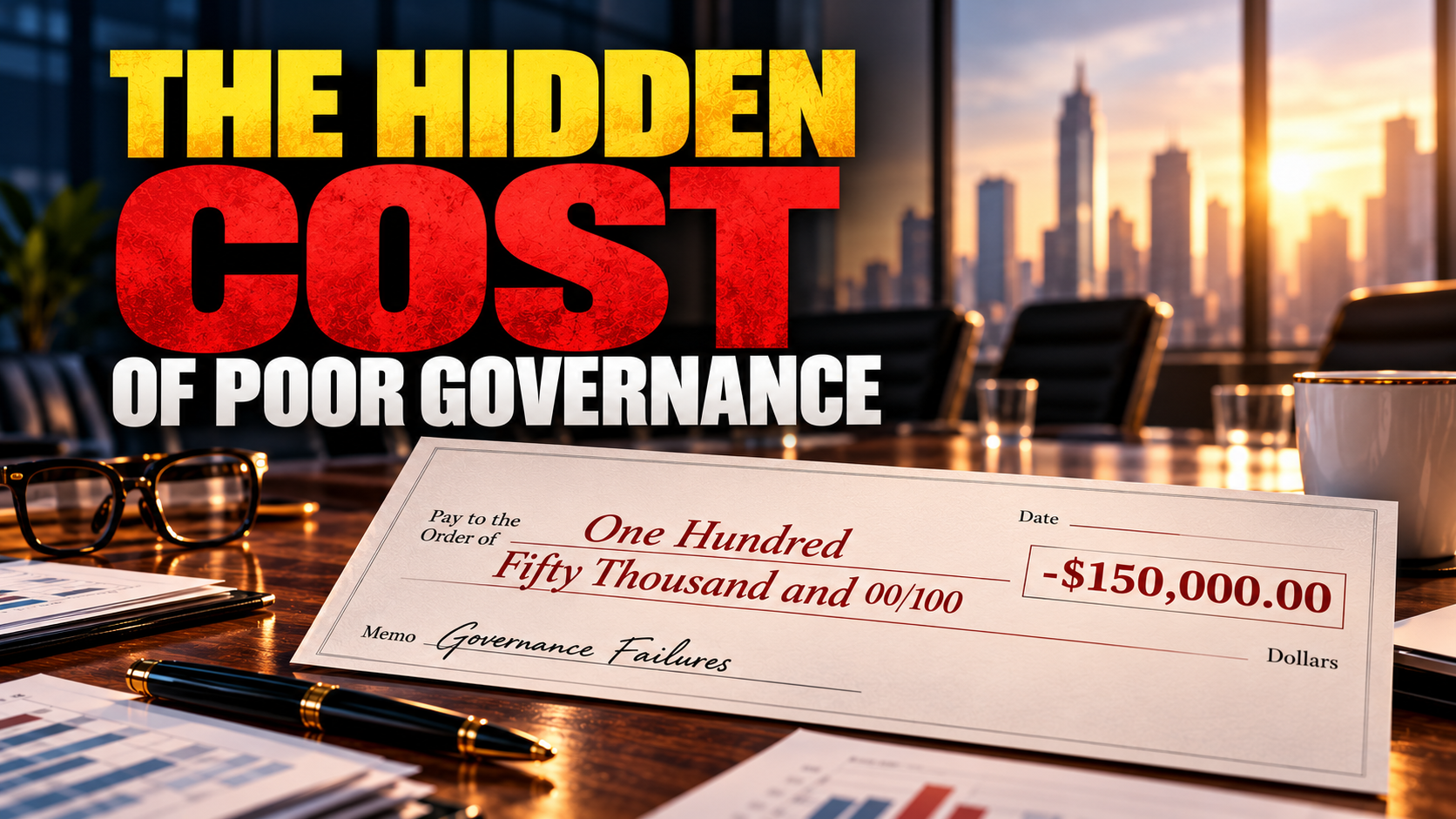
Poor governance rarely arrives with an invoice.
There is no line in the annual budget labeled board dysfunction. No financial statement neatly calculates the cost of unclear authority, unproductive meetings, board politics, repeated operational interference, or hours spent preparing directors to make decisions that should never have reached the boardroom.
That can make governance problems feel intangible.
They are not.
When governance breaks down, somebody pays.
First, the organization pays in time. Then in leadership capacity. Then in money.
Eventually, the people the organization exists to serve pay too.
Recent research is beginning to put numbers around that cost—and those numbers deserve the attention of every nonprofit board.
What Does Board Dysfunction Actually Cost?
A recent analysis by Aparna Rae in Nonprofit Quarterly puts the consequences of weak nonprofit governance in unusually direct terms.
According to the article, managing board dysfunction can consume up to 40 percent of an executive director’s operational bandwidth—time taken away from fundraising, program development, community presence, and organizational leadership. Nonprofit Quarterly
Think about that for a moment.
An organization may believe it has hired a full-time chief executive.
In practice, a poorly functioning board could be consuming the equivalent of two days of that executive’s working week.
That cost may never appear in the accounting system.
It is still a cost.
And executive time is only the beginning.
Nonprofit Quarterly also points to the money organizations repeatedly spend attempting to compensate for governance problems: consultants, retreats, interventions, organizational resets, and eventually executive replacement. When a board burns out or loses an executive director, the article estimates that simply recruiting, hiring, and onboarding a replacement can cost approximately 1.5 to two times that executive’s annual salary. Nonprofit Quarterly
That does not include everything else that leaves with the executive:
Institutional knowledge.
Relationships.
Donor confidence.
Staff stability.
Community trust.
Momentum.
A dysfunctional board can therefore become one of the most expensive problems an organization never formally measures.

The Sector-Level Cost Is Even Harder to Ignore
The same article cites a governance meta-analysis drawing on more than 50 sources and concludes that changing the way nonprofit governance is structured could save the sector at least $1.5 billion in fiscal waste. Nonprofit Quarterly
That number is striking.
But it may still underestimate the real cost.
Some governance expenses are relatively easy to identify.
Executive recruitment has a price.
Consultants send invoices.
Retreats have budgets.
Legal disputes have bills.
Other costs disappear inside the organization.
How much does it cost when a decision that should take two weeks takes four months?
What is the value of a major donor relationship the executive did not have time to develop because leadership attention was absorbed by board conflict?
What does an organization lose when senior staff begin leaving because the relationship between the board and chief executive has destabilized the workplace?
What is the cost of a missed strategic opportunity?
Those losses rarely appear under a heading called governance.
But that is where some of them begin.
Board Dysfunction Is Often an Architecture Problem
It is tempting to describe a dysfunctional board as a collection of difficult personalities.
Sometimes personalities are part of the problem.
But focusing on personality alone can obscure something more important.
Many dysfunctional boards are operating inside dysfunctional governance structures.
Directors are unclear about what belongs to them.
Executives are unclear about what authority has actually been delegated.
Committees drift into staff work.
The chair gradually becomes a shadow executive.
Management sends increasingly detailed reports because nobody knows what information the board actually requires.
Directors respond by asking increasingly operational questions.
Eventually, everybody is busy and accountability is weaker than before.
This is where governance architecture matters.
The Governance Function and the Executive Function should not compete for control of the organization.
They have different responsibilities.
The board defines the Outcome the organization exists to achieve for its Beneficiaries, approves the Investment required to pursue it, stewards the Assets necessary to sustain it, and holds the chief executive accountable for meaningful Results.
The executive leads the Activities required to produce those Results.
When those responsibilities are clear, both functions become stronger.
When they are repeatedly mixed together, the organization begins paying for the confusion.
Forty Percent Is Not Engagement
There is an uncomfortable implication in the 40 percent figure reported by Nonprofit Quarterly.
Boards sometimes interpret high levels of interaction with the executive as evidence that they are highly engaged.
That is not necessarily true.
A board can be extremely active and still govern poorly.
Directors can spend hours reviewing operational details, requesting additional reports, revisiting management decisions, debating implementation, and participating in staff work.
Everybody may leave the meeting exhausted.
Nothing about that guarantees effective governance.
The important question is not:
How much time does our board spend?
It is:
What does that time produce?
If an executive must devote an extraordinary portion of leadership capacity to managing the board itself, the board should not automatically congratulate itself for being engaged.
It should ask why.
Is the board receiving the wrong information?
Are responsibilities unclear?
Has authority been delegated ambiguously?
Are board meetings focused on Activities instead of Results?
Has the board defined what success actually looks like for the Beneficiary?
Those questions lead somewhere useful.
More board activity does not necessarily do so.
We explored this problem more directly in Why Nonprofit Boards Micromanage—and How to Stop It. Micromanagement is rarely solved by asking directors to become less interested. The more durable solution is giving the board something more important to govern.
Bad Governance Also Distorts What the Board Measures
The Nonprofit Quarterly article highlights another problem that deserves more attention.
In research involving 924 nonprofit directors, more than a quarter did not believe their fellow board members adequately understood the organization’s mission and strategy. Nearly one-third were dissatisfied with the board’s ability to determine whether the organization was actually achieving meaningful impact. And 46 percent had little or no confidence that the information they were receiving adequately measured whether the work was succeeding. Nonprofit Quarterly
That last number may be the most important.
A board cannot govern effectively if it cannot distinguish activity from Results.
Organizations can produce enormous amounts of information:
Programs delivered.
People contacted.
Events held.
Reports completed.
Meetings conducted.
Funds raised.
Services provided.
Those figures can be useful.
But they do not automatically answer the governance question.
Is the condition of the Beneficiary changing in the way the organization exists to change it?
This is why Impact Governance begins with the Outcome rather than the activity.
The Outcome describes the change the organization exists to create.
Results provide evidence that movement toward that Outcome is occurring.
Activities are the work management carries out to produce those Results.
Confusing the three creates an organization that can become extraordinarily busy while remaining uncertain whether it is succeeding.
The Most Expensive Governance Problem May Be Board Drift
A board usually does not decide one morning to abandon governance.
It happens gradually.
A program discussion becomes a staffing discussion.
A staffing discussion becomes a conversation about scheduling.
A financial discussion becomes a debate over a vendor.
A director offers to help with implementation.
Another director begins communicating directly with staff.
A committee starts managing work instead of governing it.
No single moment appears catastrophic.
That is why Board Drift can be so difficult to detect.
The board slowly moves away from Beneficiaries, Outcomes, Results, Assets, and Investment and toward Activities.
The result is not merely an irritated executive.
The organization loses clarity about who is accountable for what.
And once accountability becomes ambiguous, performance becomes harder to evaluate.
Fix the System Before Replacing the People
When board problems become visible, organizations frequently jump to structural changes that sound decisive.
Replace the chair.
Add a committee.
Rewrite the bylaws.
Recruit three new directors.
Hold a retreat.
Change the meeting schedule.
Any of those actions may be useful.
None automatically fixes governance.
A board composed of extraordinarily accomplished people can still operate inside a weak system.
If directors do not share a clear understanding of their responsibility, adding more expertise may simply produce more sophisticated disagreement.
This is why a practical Board Governance Manual should do more than collect policies.
It should answer a much more useful question:
How do we govern here?
That means creating shared expectations around authority, accountability, decision-making, the relationship between the Governance and Executive Functions, and the standards by which board performance itself will be evaluated.
The objective is not another binder.
It is less ambiguity.
Governance Should Create Capacity, Not Consume It
A strong board should increase the organization’s capacity to pursue its mission.
It should provide clarity.
It should protect Assets.
It should strengthen accountability.
It should make difficult decisions possible.
It should ensure that the Investment being made is producing Results that matter.
And it should give the chief executive enough clarity and authority to lead the Executive Function effectively.
When the opposite is happening—when the board consistently consumes leadership capacity, delays decisions, creates operational confusion, or makes accountability harder—the board has become part of the organization’s cost structure.
That should be treated as seriously as any other major inefficiency.
For continuing analysis of governance risks, research, and emerging board issues, visit Impact Governance Board Governance News.
Stop Paying for Governance Problems You Can Fix
The numbers make the stakes difficult to dismiss.
Up to 40 percent of executive bandwidth lost to board dysfunction.
Approximately 1.5 to two times an executive’s salary to replace leadership after turnover.
At least $1.5 billion in potential sector-wide fiscal waste associated with outdated governance architecture. Nonprofit Quarterly
But the real cost is larger than any of those figures.
Every hour consumed by unnecessary governance friction is an hour unavailable for leadership.
Every dollar spent repeatedly correcting structural problems is a dollar unavailable for impact.
Every talented executive driven out by preventable governance dysfunction takes knowledge and relationships with them.
And every organizational resource consumed without improving Results ultimately represents capacity that did not reach the Beneficiary.
That is why fixing governance cannot stop at making board meetings more pleasant.
Impact Governance helps nonprofit boards and executives fix the structure underneath the problem.
Through our nonprofit governance consulting services, we help organizations clarify the Governance and Executive Functions, establish meaningful Lanes of Accountability, define the Outcome and Results the board should govern toward, strengthen board-executive alignment, improve the information reaching the board, and build governance practices that continue working after the consulting engagement ends.
The goal is not simply a better board meeting.
It is to recover executive capacity, reduce governance friction, strengthen accountability, protect leadership, and return organizational attention and resources to the mission.
If your executive team is spending too much time managing the board, responsibilities are unclear, decisions repeatedly stall, or governance is beginning to affect leadership stability, waiting has a cost.
Fix the structure before you pay for the consequences.
Contact Impact Governance to discuss what is happening in your boardroom and how we can help fix it
Board Governance News Today
Explore insights, updates, and thought leadership from Impact Governance on nonprofit board governance, leadership practices, and organizational management.


Leave a Reply