
A board can be filled with experienced, intelligent, and deeply committed people—and still struggle to govern effectively.
The problem is not always a lack of expertise.
Sometimes, it is a lack of clarity.
Board members may understand their legal responsibilities. They may know how committees work. They may receive financial reports, executive updates, and strategic information. Yet when an important decision arrives, they may still wonder:
Is this our decision?
Is this management’s decision?
How involved should we be?
Those questions are at the heart of effective Board Governance Training.
Good Governance Requires More Than Knowing the Rules
Traditional board training often emphasizes legal duties, fiduciary responsibilities, policies, and committee structures. Those things matter.
But understanding the rules does not automatically teach people how to govern.
The Impact Governance framework makes an important distinction: many capable board members come from professional or activist backgrounds where they are accustomed to solving problems and taking action. Governance asks them to do something different. Much of the work involves asking the right questions and maintaining a sustained focus on the Beneficiary and the intended Outcome.
That shift can be surprisingly difficult.
A person may be an excellent lawyer, accountant, engineer, entrepreneur, educator, or community leader and still need to learn what effective board governance looks like.
Professional expertise matters.
Governance expertise matters too.
The First Step Is Understanding the Two Functions

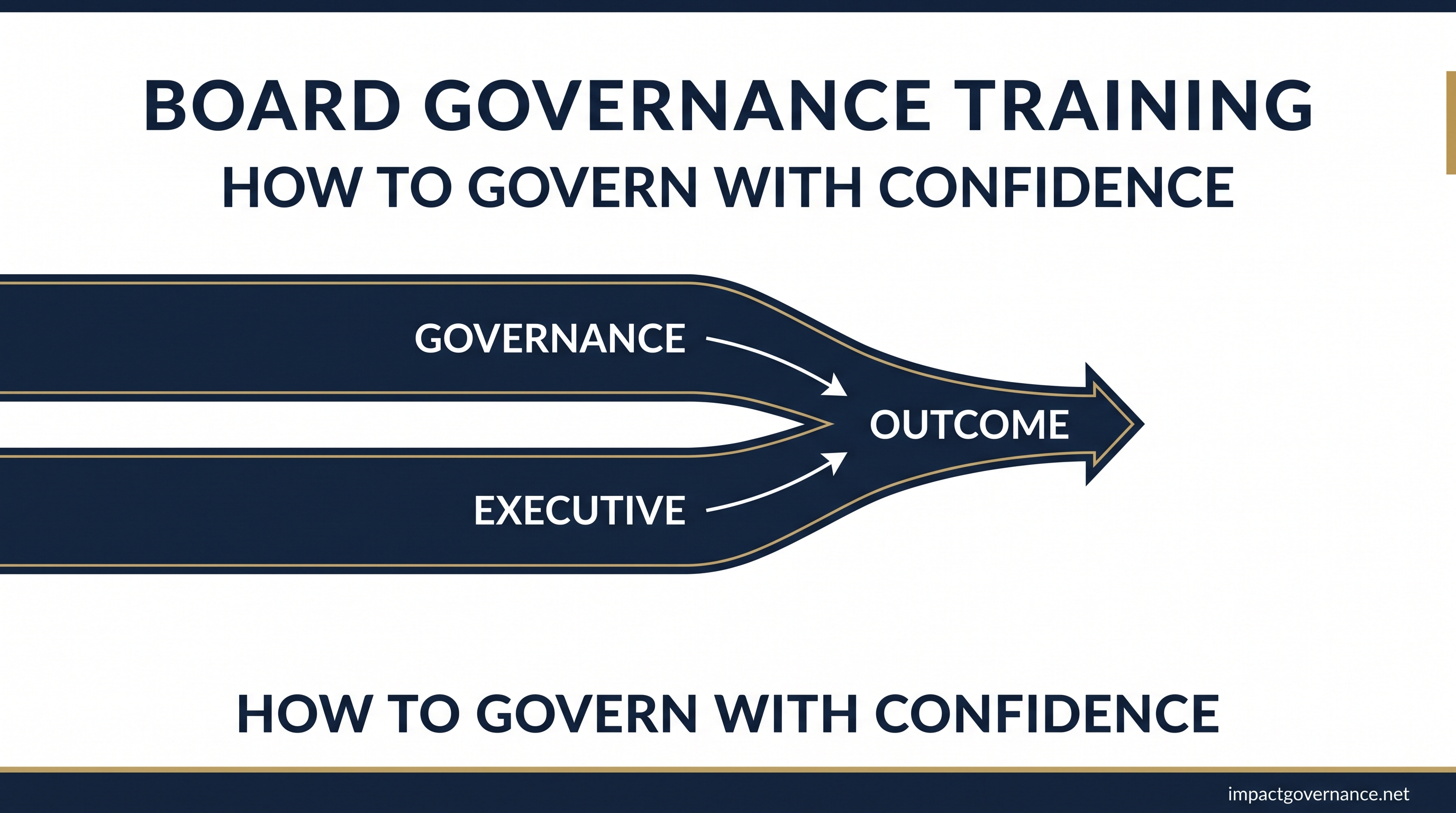
The Impact Governance Model begins by distinguishing between the Governance Function and the Executive Function.
Both are necessary.
Both work toward the same impact.
But they are not interchangeable.
The board’s role is to govern.
The chief executive and executive team’s role is to execute.
The distinction sounds simple, but it becomes much more important when decisions become complicated.
The board helps define the Beneficiary and the Outcome the organization seeks to achieve. It determines the level of Investment and holds the executive accountable for measurable results.
The executive function determines how the organization will operate, what programs and services to deliver, how the team will be structured, and how the organization’s day-to-day work will be carried out.
The two functions need to communicate.
They need to collaborate.
They need to challenge and support each other.
But they should not become the same function.
Role Clarity Changes the Quality of Decisions
One of the most practical benefits of governance training is helping board members understand who decides what.
The Impact Governance framework describes this distinction through questions.
For example, the board considers questions such as:
- Who is the Beneficiary?
- What change does the Beneficiary seek?
- How much are we willing to invest?
- What measurable Results should be achieved?
- What strategic Assets must be protected?
- Is the chief executive performing well?
- Is the board performing well?
The chief executive, meanwhile, addresses questions such as how the Investment will be used, which programs and services should be delivered, how the organization should be structured, and who should be on the team.
This does not mean the board and executive should never discuss these issues together.
They should.
The important point is understanding who ultimately owns the decision.
When that distinction is unclear, people can step on one another’s responsibilities, decisions can slow down, and frustration can grow.
When it is clear, both sides can operate with greater confidence.
Training Should Help Boards Ask Better Questions

Effective Board Governance Training should therefore go beyond presenting information.
It should help board members practice governance.
That means learning how to recognize the difference between a governance question and an executive question.
Consider a few examples.
A board wants to consider a new program serving a population it has not previously served.
That is a governance question.
The organization needs to replace a departing HR director.
That is an executive question.
The organization needs additional resources because unexpected inflation has changed its financial position.
That may require a governance decision.
The executive team needs to determine how to raise additional money effectively.
That belongs in the Executive Function.
Exercises like these make governance practical.
They help directors recognize that being a good board member is not about being involved in every decision.
It is about being involved in the right decisions.
The Goal Is Not to Make Boards Less Involved
Role clarity is sometimes misunderstood as telling boards to “stay out of management.”
That is too simplistic.
A strong board should be engaged.
It should ask difficult questions. It should examine Results. It should challenge assumptions. It should hold leadership accountable. It should make important decisions about purpose, direction, Investment, and stewardship.
What it should not do is quietly move into the Executive Function because it believes that more involvement automatically means better governance.
The Impact Governance Model uses a two-lane road to illustrate this relationship. One lane represents the Governance Function. The other represents the Executive Function. They travel side by side toward the same destination.
That image captures an important principle:
Alignment does not require identical roles.
In fact, strong alignment depends on respecting the difference between them.
Why Role Clarity Builds Trust
Role clarity is not only about efficiency.
It also affects trust.
When board members and executives understand where their responsibilities begin and end, there is less second-guessing, less frustration, and less duplication. The organization can move more confidently because people understand the authority they hold and the expectations attached to it.
The relationship between the board and chief executive is especially important.
The board should not become a “shadow chief executive,” and the chief executive should not determine what the board is permitted to discuss. Both should be able to communicate openly about what the board needs to know and where a decision belongs.
That is not separation for separation’s sake.
It is clarity in service of a shared Outcome.

Training Should Connect Governance Back to Impact
There is another reason Board Governance Training matters.
Boards can easily become absorbed by activity.
Reports. Meetings. Committees. Policies. Fundraising. Operational updates.
All of those things may matter, but the Impact Governance framework keeps returning the board to a more fundamental question:
What change are we trying to create for the people we exist to serve?
The board’s responsibility is closely connected to Results, stewardship of resources, and maintaining focus on the mission and Beneficiaries.
Training becomes more meaningful when board members can connect their decisions to that purpose.
Instead of simply asking whether something is being done, they can ask whether it is helping produce the intended Outcome.
Instead of simply reviewing a report, they can ask what the Results tell them.
Instead of becoming involved in an operational problem, they can determine whether the issue actually requires a governance decision.
That is the difference between knowing about governance and practicing governance.
A Board Governance Manual Can Reinforce What Training Teaches
Training can establish a shared foundation.
A Board Governance Manual can help reinforce that foundation over time.
When directors have a practical reference for governance roles, responsibilities, decision-making, and shared terminology, the principles introduced through training do not have to disappear after a workshop or orientation session.
The manual can become part of how new board members learn their role and how existing directors return to the same framework when difficult questions arise.
Board Governance Training and a Board Governance Manual therefore serve different purposes—but they can strengthen each other.
Building a Board That Can Govern With Confidence
A strong board is not necessarily the board with the most experts.
It is the board that understands its responsibility, keeps the Beneficiary visible, asks the right questions, makes the decisions that belong to it, and allows the executive function to execute within its own lane.
That kind of governance does not happen automatically.
It requires a shared understanding.
It requires practice.
And it requires the confidence to know when the board should lead, when it should ask, and when it should allow management to execute.
That is the real purpose of Board Governance Training.
Not simply to teach directors more information.
To help them govern better.
Build Greater Governance Confidence
If your board needs more than a traditional orientation session—if directors need to develop a clearer understanding of their governance role, strengthen board-executive alignment, and learn how to make better governance decisions—Impact Governance Board Governance Training provides a practical framework for building that capability.
Our approach is designed to help boards and executives understand their distinct responsibilities, work from a shared framework, and keep governance focused on meaningful Outcomes for the people the organization exists to serve.
Explore our Board Governance Training program and learn how your board can build the clarity, discipline, and confidence to govern more effectively.
Leave a Reply