
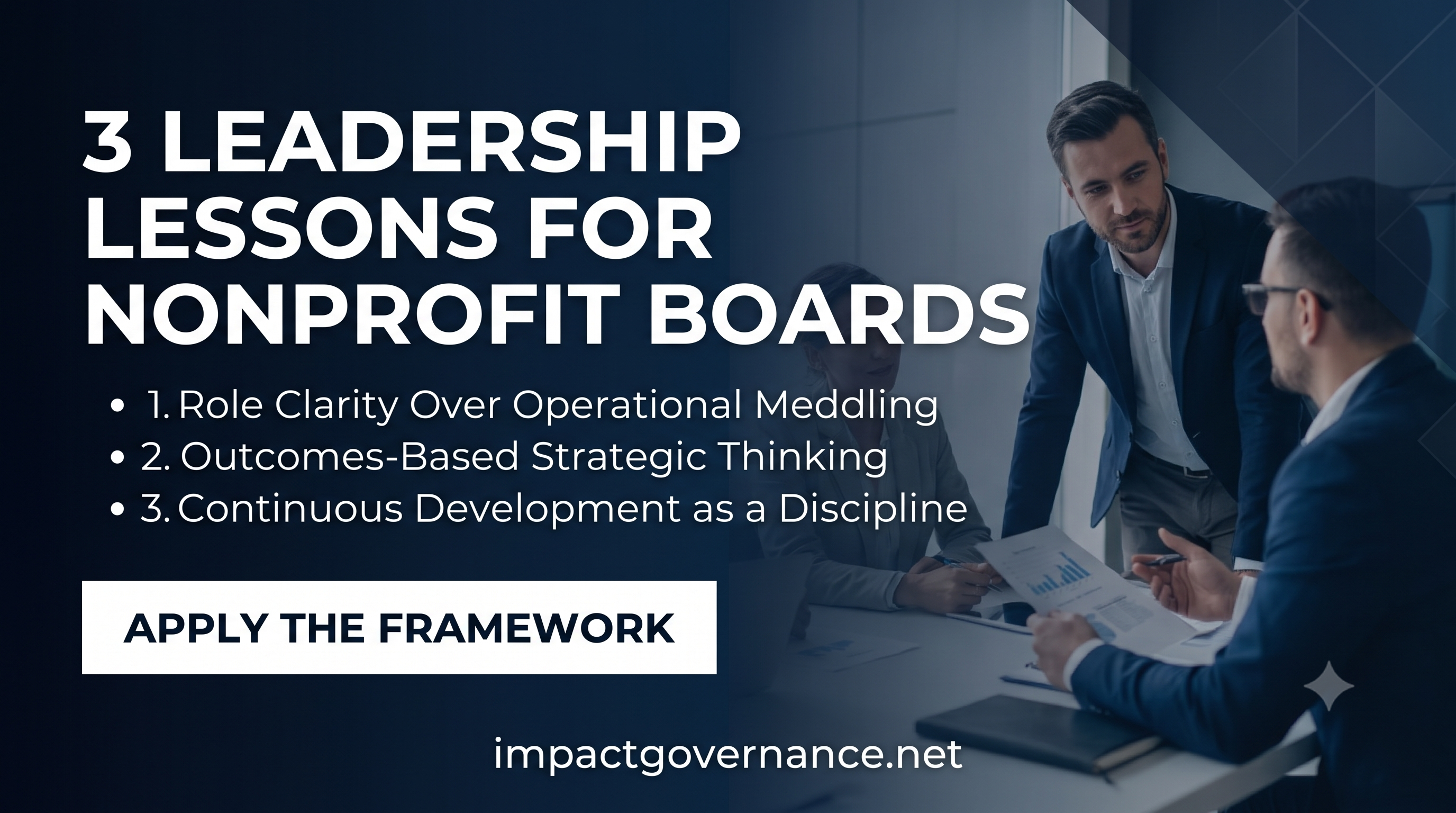
Board governance is evolving faster than ever. As organizations navigate technological change, leadership transitions, and growing accountability expectations, boards are being challenged to rethink how they lead.
This week’s governance news highlights three important lessons that apply not only to corporations, but also to nonprofit organizations seeking stronger governance systems and long-term organizational effectiveness.

Does Your Board Still Match Your Organization?
One of the most interesting governance articles published this week asks a simple but powerful question:
Does your board still match the organization it serves?
As organizations grow, change priorities, or enter new strategic phases, boards must also evolve. A board that was effective five years ago may not possess the experience, diversity of perspectives, or governance capabilities needed today.
Rather than viewing board composition as permanent, the article encourages organizations to regularly evaluate whether board skills continue to align with organizational strategy.
📖 Read the complete article here:
https://capital-riesgo.es/es/articles/when-boards-don-t-match-the-business
What this means for nonprofit boards
One of the principles emphasized throughout the Impact Governance® framework is that governance should evolve alongside organizational purpose.
Regular board evaluations, succession planning, and governance reviews help organizations maintain alignment between leadership and mission rather than relying solely on historical board composition.

AI Is No Longer an IT Issue—It Is a Governance Responsibility
Artificial intelligence is rapidly becoming a boardroom topic.
A recent article on charity governance argues that AI should not be viewed simply as another technology initiative. Instead, boards have a stewardship responsibility to ensure that AI is implemented ethically, transparently, and in ways that support organizational purpose.
For nonprofit organizations, this represents an important shift in governance thinking.
📖 Read the complete article here:
What this means for nonprofit boards
Technology decisions increasingly influence governance decisions.
Boards should understand:
✔ AI governance and oversight
✔ Ethical accountability
✔ Risk management
✔ Transparency
Strong governance requires boards to ask not only “Can we use AI?” but also “Should we, and how will we govern its use responsibly?”
Preparing Today’s Board for 2030
Governance experts are already encouraging boards to think beyond today’s challenges.
Another recent article explores the changing role of board chairs and directors as organizations prepare for 2030.
The message is clear:
Future boards must become more adaptive, strategic, and capable of leading through uncertainty rather than simply reacting to it.
📖 Read the complete article here:
What this means for nonprofit boards
Preparing for the future is not about predicting every challenge.
It is about building governance systems that remain effective regardless of how circumstances change.
Organizations that continuously develop board capabilities, strengthen governance practices, and encourage strategic thinking are more resilient over time.
One Common Theme Connects These Stories
Although these articles discuss different topics, they point toward the same conclusion.
Successful governance depends on continuous improvement.
Boards must be willing to:
✔ Review their composition
✔ Invest in governance education
✔ Adapt to emerging technologies
✔ Strengthen strategic leadership
✔ Build governance systems that evolve with the organization
These are not one-time activities—they are ongoing governance responsibilities.
Many organizations discover that strengthening governance starts with a shared understanding of roles, accountability, and decision-making.
Explore the Board Governance Training program to help your board build stronger governance practices:
A structured governance framework can also provide practical guidance for boards seeking greater clarity and consistency in decision-making.
Final Insight
The strongest boards are not those that simply respond to change.
They are the ones that prepare for it.
Whether the challenge is board composition, artificial intelligence, or future leadership, governance remains most effective when it is intentional, structured, and continuously improved.
For organizations seeking to strengthen board effectiveness, governance education and practical frameworks provide a foundation for sustainable leadership and long-term organizational impact.

Leave a Reply