

Every nonprofit organization has one tucked away on a shelf or saved in a secure digital folder: the Board Governance Manual. It is typically a thick binder or a dense PDF packed with bylaws, conflict-of-interest policies, committee charters, financial statements, and a copy of the original IRS determination letter.
When a new board member joins, this manual is handed over with pride. It is treated as the definitive roadmap for leadership success.
Yet, despite having a comprehensive board governance manual, many executive directors and board chairs still find themselves trapped in a cycle of frustration. Board members remain disengaged, meetings lack strategic depth, and the boundaries between staff operations and board oversight remain chronically blurred.
Why does a standard board governance manual fail to drive alignment and momentum?
Because traditional manuals are built for legal compliance, not operational clarity. They outline what is legally permissible, but they completely fail to teach how a board should actually think, behave, and govern.

The Compliance Trap: Why Traditional Manuals Fall Short
A standard compliance-driven manual treats governance as a checklist. It tells a board member how many meetings they must attend, how committees are structured, and how to vote on resolutions.
While these administrative boundaries are necessary, they are entirely retrospective and protective. They are designed to prevent the organization from breaking the law or mismanaging funds. What they don’t do is tell the board how to actively drive the organization forward.
Without a clear, conceptual framework to guide daily decision-making, boards suffer from Board Drift. Over time, even the most passionate board members slowly lose focus. Meetings devolve into passive “show-and-tell” sessions where the chief executive reads retrospective slide decks, and the board simply rubber-stamps decisions.
Worse, when a manual fails to establish psychological boundaries, board members often step over the line into staff territory—micromanaging programs, events, and operational details—while leaving the true strategic future of the organization completely unguided.
Transforming Your Manual with the Four Disciplines of Clarity
To turn your board governance manual from a dusty compliance record into a living framework for impact, it must be anchored in the Discipline of Clarity. True leadership alignment requires absolute agreement on four foundational pillars:
1. Clarity About Beneficiaries (Who)
The board’s ultimate responsibility is to stand in for the community and stand up for those the organization serves. Your manual should explicitly define the primary beneficiary. If the board isn’t crystal clear on who the organization exists to serve, it cannot effectively judge whether the organization is succeeding.
2. Clarity About Change (What and Why)
A high-performing board does not manage programs; it governs outcomes. The manual must establish that the board’s primary domain is defining the Outcome—the high-level, structural transformation the organization seeks to create—and the Investment required to achieve it.
3. Clarity About Roles (The Two-Lane Road)
Your governance documents must draw a sharp, psychological line between the Governance Function and the Executive Function.
- The Board owns the “What” and “Why.” It operates as a flat structure where collective wisdom and consensus dictate direction.
- The Chief Executive owns the “How.” The executive operates within a hierarchical pyramid, making fast, operational decisions to deploy staff, manage daily activities, and execute the strategy.
When the board stays in its lane and holds the executive accountable to the destination rather than micromanaging the vehicle, trust thrives.
4. Clarity About Results (How We Measure)
A transformational manual shifts the board’s attention away from tracking internal activities (the number of meetings held or flyers printed) and focuses it squarely on tracking results and outputs that prove progress toward the ultimate beneficiary outcome.
Upgrade Your Leadership Roadmap: Join the Waitlist
If your leadership team is struggling with role confusion, passive meetings, or strategic stagnation, adding more policy templates to your current binder won’t solve the problem. You don’t need more compliance rules; you need a paradigm shift.
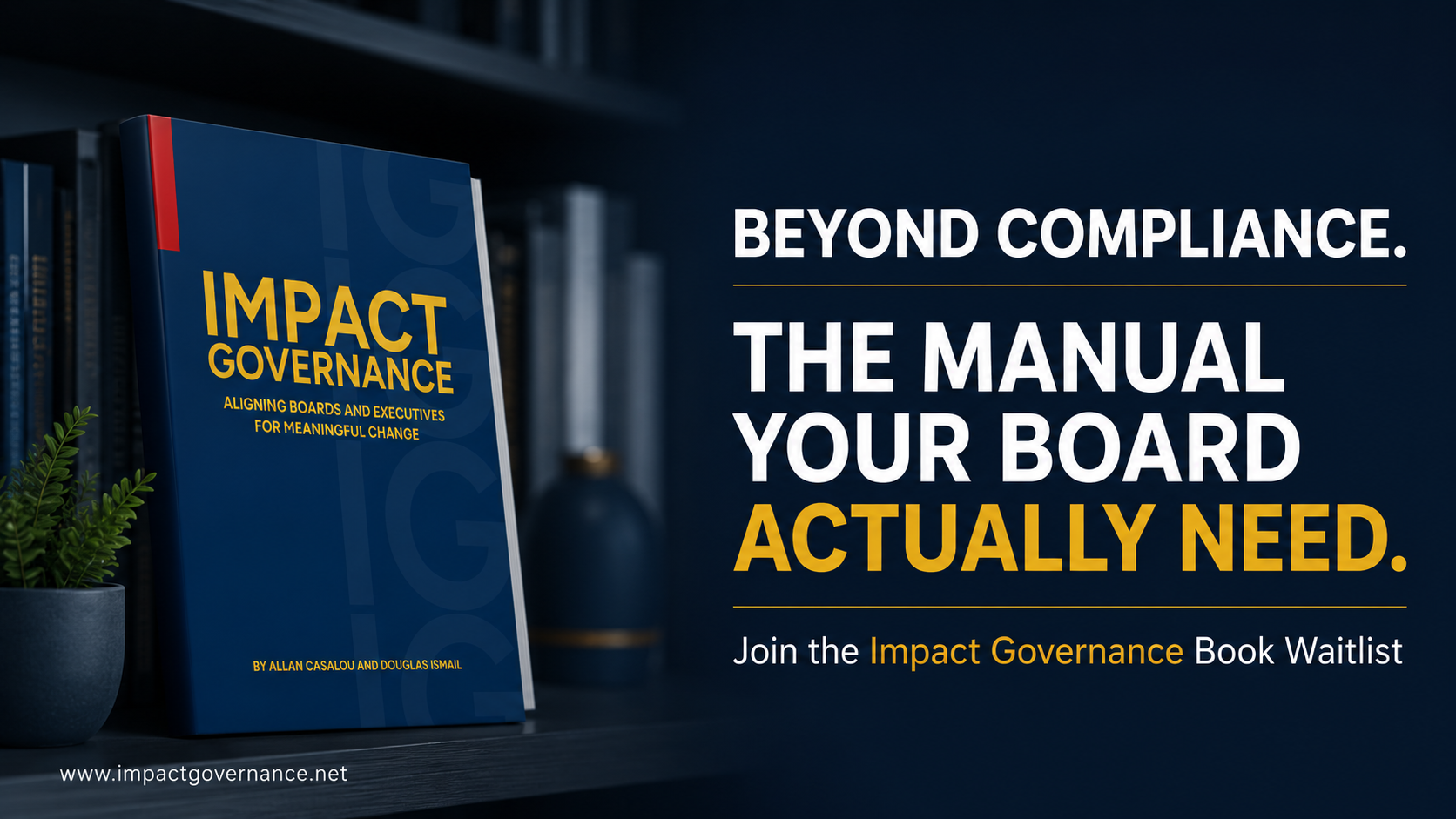
We have codified this exact methodology into the definitive blueprint for modern nonprofit leadership: “Impact Governance: Aligning Boards & Executives for Meaningful Change” by Allan Casalou and Doug Ismail.
This isn’t just another theory book. It is the tactical, real-world manual that bridges the gap between compliance and true organizational transformation. It provides the exact language, frameworks (like the Mixing Bowls Metaphor), and structures you need to eliminate board drift forever.
Don’t let your leadership team navigate governance in the dark. Click here to join the exclusive book waitlist today and be the first to secure the ultimate manual your board actually needs to drive meaningful change.
Master the Audit. Get the full diagnostic tools and implementation worksheets by joining the waitlist for our new book: Impact Governance: A Complete Guide.
For additional insights into nonprofit governance and how organizations are addressing these challenges, you can explore more articles here: https://impactgovernance.net/board-governance-news/
If your organization is ready to move beyond surface-level solutions and strengthen its governance foundation, you can schedule a consultation with Impact Governance here: https://impactgovernance.net/contact/
Leave a Reply