
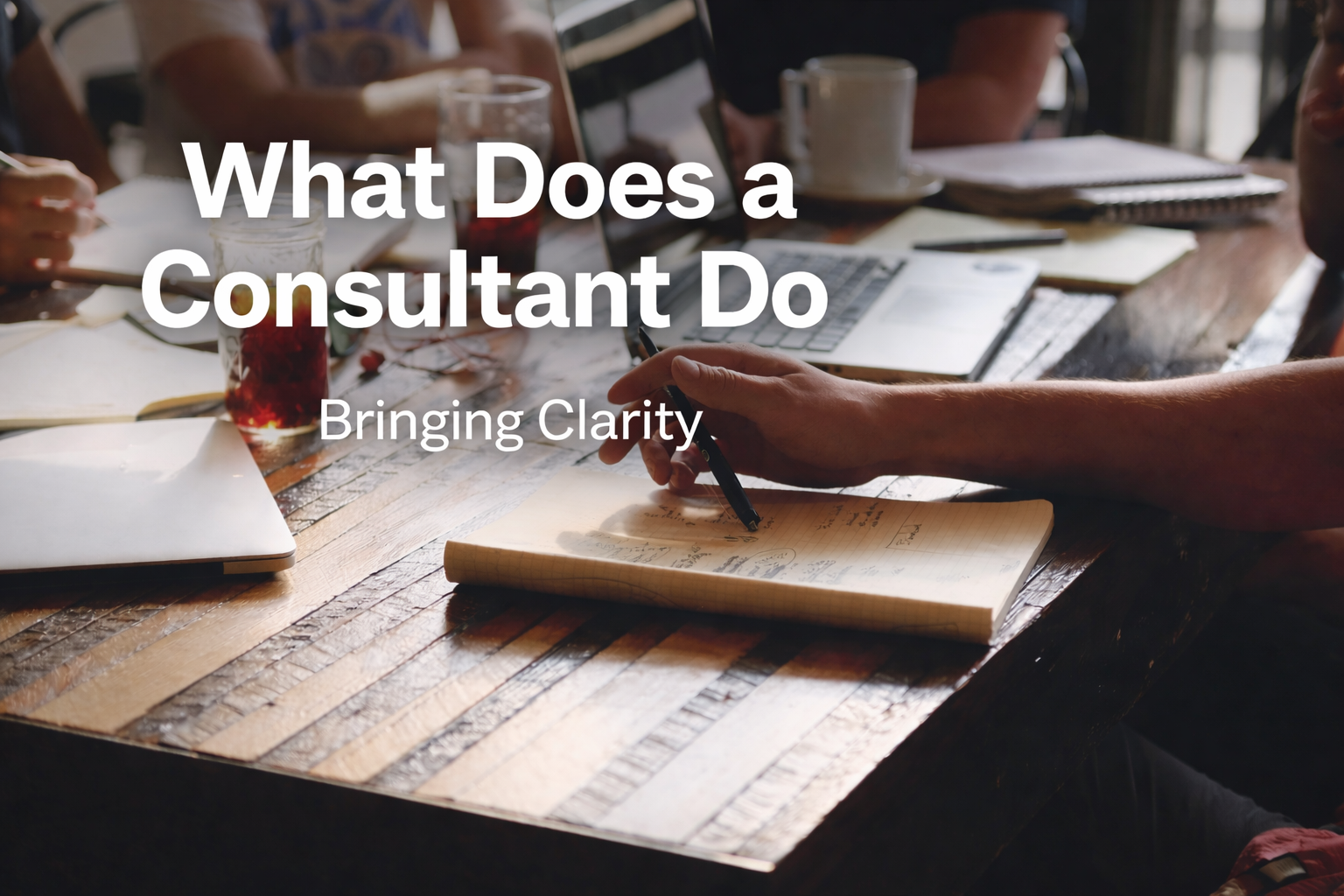
The role of a nonprofit consultant is often misunderstood.
Some organizations see consultants as problem solvers brought in during moments of crisis. Others see them as advisors who provide recommendations from the outside. In reality, the most effective nonprofit consulting work is not about quick fixes or generic advice.
It is about creating clarity where it is missing.
Many organizations reach out to a nonprofit consultant when something feels off. Decisions are taking longer. Priorities are not fully aligned. Leadership and governance are both working hard, but not always moving in the same direction.
Nothing is obviously broken.
But the work feels heavier than it should.
This is where consulting becomes valuable.
A strong nonprofit consultant does not start by adding more structure or more processes. Instead, they focus on understanding how responsibility is currently being held across the organization. In many cases, the issue is not effort or capability. It is that key responsibilities have never been clearly defined.
This often shows up in governance.
Boards are active and engaged, but not always clear about what they are accountable for. Leadership is responsive and committed, but not always supported by consistent direction. Over time, both sides begin to compensate for this lack of clarity.
A nonprofit consultant helps bring that into focus.

Some of the most common areas where consultants support organizations include:
• Clarifying the role of the board and leadership
• Aligning decision-making around shared priorities
• Identifying where governance is creating friction
• Strengthening how accountability is defined and carried
These are not surface-level changes.
They go to the core of how an organization operates.
One of the key differences between effective and ineffective consulting is where the work is focused. Many consultants focus on outputs—plans, recommendations, or frameworks. While these can be useful, they often do not address the underlying issue.
Without clarity, new tools simply add more complexity.
Effective nonprofit consulting focuses on orientation.
It helps organizations answer fundamental questions.
What are we responsible for?
What matters most over time?
How should decisions be evaluated?
When these questions are answered clearly, everything else becomes easier. Meetings become more focused. Decisions become more consistent. Roles become easier to navigate.
We have seen this in organizations that initially came to us for specific issues, such as board engagement or strategic alignment. In many cases, those issues were symptoms of a deeper problem. Once the organization clarified how responsibility was structured, the original challenges became easier to address.
This is why the value of a nonprofit consultant is not just in solving problems.
It is in helping organizations see their work more clearly.
That clarity creates lasting change.
If you want to explore how governance and organizational clarity evolve in practice, our board governance insightsshare perspectives on how boards and leadership teams improve effectiveness over time.
For a deeper understanding of how governance shapes organizational performance, our board governance book outlines a practical approach to defining accountability and strengthening decision-making.
Not every organization needs a consultant.
But when the work starts to feel unclear, or when effort no longer leads to better outcomes, outside perspective can be valuable.
A nonprofit consultant does not replace leadership or governance.
They help both function more effectively.
If your organization is working hard but still facing unclear decisions or misalignment, it may be time to bring in outside perspective. Schedule a consultation to explore where clarity can improve your organization’s effectiveness.
Master the Audit. Get the full diagnostic tools and implementation worksheets by joining the waitlist for our new book: Impact Governance: A Complete Guide.
Leave a Reply