
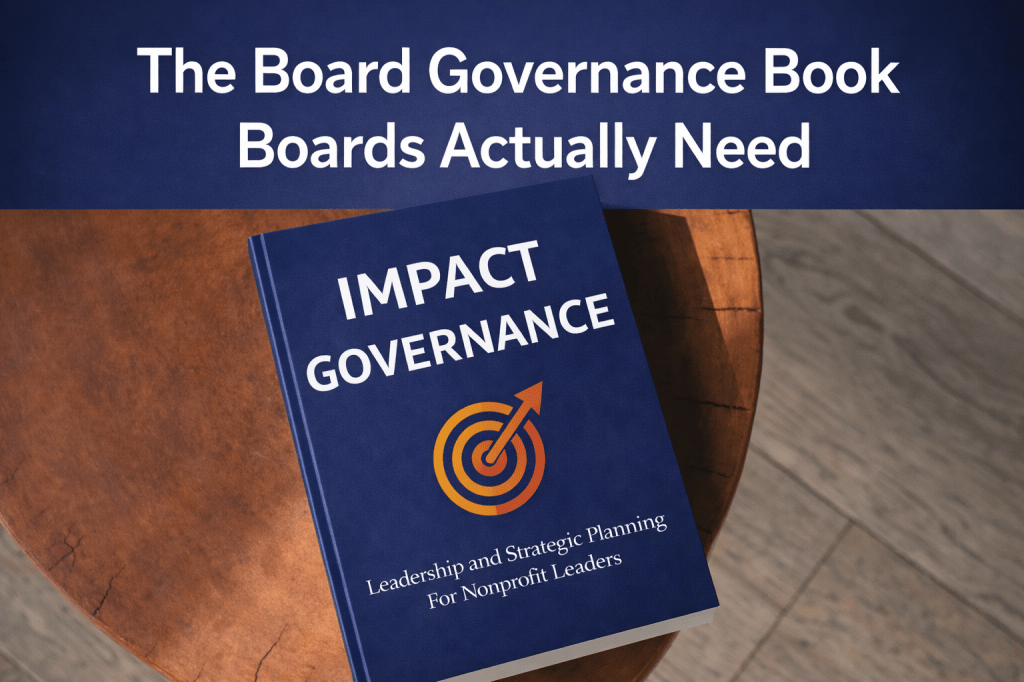
If you search for a board governance book, you will find no shortage of options.
Most board governance books explain fiduciary duties.
They outline compliance requirements.
They describe board structure, committees, and strategic planning processes.
These are necessary foundations. But they do not answer the question many experienced board members quietly carry:
Why does governance still feel heavier than it should?
A serious board governance book must go beyond structure. It must address responsibility.
What Most Board Governance Books Focus On
A traditional board governance book typically covers:
- Legal roles and responsibilities
- Nonprofit board best practices
- Board–executive boundaries
- Strategic oversight
- Governance compliance
These topics matter. But governance strain rarely comes from ignorance of roles. It comes from responsibility without clarity.
Boards are active. They review reports, approve budgets, assess risk, and support leadership. Yet meetings feel dense. Decisions stall. Disagreement feels personal rather than principled.
The issue is not competence.
It is orientation.
A Different Kind of Board Governance Book
Impact Governance was written as a board governance book for boards that are already serious.
It does not offer templates or governance checklists alone. Instead, it examines how boards:
- Lose clarity even when they care deeply
- Drift toward activity instead of accountability
- Experience responsibility without authority
- Confuse oversight with stewardship
This board governance book introduces a disciplined framework built around four governing commitments:
- The Outcome the board is accountable for stewarding over time
- The Results used for learning, not performance
- The Assets that must not be depleted
- The Investment the board is willing to make
These commitments shift governance from supervision to long-term stewardship.
They give boards a governing anchor.
Why the Right Board Governance Book Matters
Nonprofit governance is becoming more complex. Financial pressures, political scrutiny, leadership transitions, and public expectations increase the weight boards carry.
When complexity increases, governance must become clearer—not louder.
Boards without clarity respond by meeting more often, requesting more data, and tightening oversight. The work expands, but confidence does not.
The right board governance book does not add more activity. It restores coherence.
It helps boards name what they are accountable for holding steady across time, so decisions can be evaluated against durable commitments rather than urgency.
Reading Is the Beginning
A board governance book can introduce a discipline.
But living that discipline requires structured work. Clarity must be articulated, tested, and embedded in meeting design, decision framing, and board–executive partnership.
For boards ready to move from insight to implementation, reading is the beginning—not the end.
You can learn more about Impact Governance at ImpactGovernance.net.
And for boards seeking to translate governing clarity into practice, our work with boards, executives, and funders goes deeper.
 IMPACT GOVERNANCE
Leave a comment